
In October 2026, attackers went after PHP2Shell four days before a fix existed. Nearly every WAF provider published a rule within about a day. What separated customers was how much work it took before that rule actually blocked an attack.
In brief
- Attackers moved first. An exploit attempt against PHP2Shell came four days before the fix. Named attack tools appeared on the morning the fix was published.
- A rule was not the same as protection. Depending on their provider, customers had to opt in, switch to blocking, update appliances or write their own rules.
- Patching remains the fix. Protection that is already on is what covers the days before the last server is patched.
Four days early
On 17 October 2026, an Amazon honeypot logged an attempt to exploit a PHP flaw that did not officially exist yet. The fix shipped four days later, on 21 October. By the time most security teams read the advisory, attackers had a head start measured in days, not hours.
Within a week, two of the most widely deployed web runtimes had critical remote code execution flaws. One was in PHP itself (“PHP2Shell”, CVE-2026-109618 and CVE-2026-109619). The other was in the Brotli decoder bundled with Node.js (CVE-2026-111497). Both were found with the help of AI. Both were on CISA’s list of actively exploited vulnerabilities within six days of their fixes.
Four weeks on, the record is clear enough to ask a harder question than “who had a rule?”. The better question is which customers were actually protected in the first hours, and how much work it took them to get there.
The window opened before the patch
AI-assisted research is finding deep bugs in mature code faster than ever. PHP2Shell was co-disclosed by Wiz, OpenAI, Calif and Quarkslab. The Node.js Brotli flaw was reported by OpenAI’s Codex Security. These are not obscure plugins. They are core runtimes that sit under a large share of the web.
The same speed works for attackers. Once a fix is public, the patch itself shows where the bug is. For PHP2Shell, attackers did not wait for the patch.
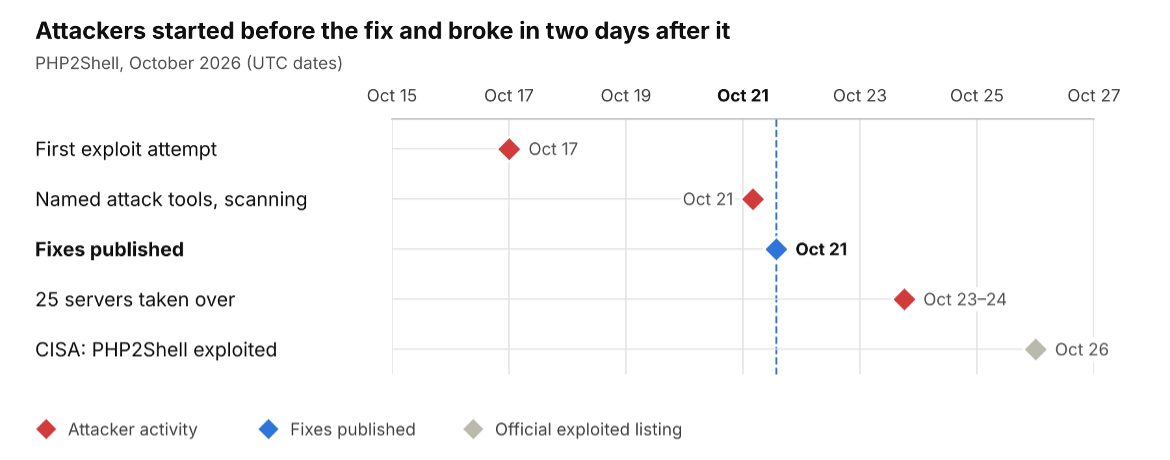
An exploit attempt came four days before the fix. Named attack tools and scanning appeared on 21 October, hours before the fix was published. Two days later, attackers chained PHP2Shell with a Linux kernel flaw to take over 25 internet-facing servers, including systems at a US government-affiliated organization. CISA listed PHP2Shell as exploited five days after the fix.
The old assumption was that defenders had weeks between a patch and widespread exploitation. In October that window was days, and for PHP2Shell it opened before the patch existed.
Why patching alone couldn’t close the gap
Patching is the fix, and it always will be. But in both incidents, patching everything quickly was harder than it sounds.
- Code hid in places teams don’t track. The Brotli decoder ships inside Node.js, Bun, .NET, Envoy, Istio and Python packages. Some paths start from a file, not a web request. PHP also runs inside appliances, and attackers used PHP2Shell against firewall admin pages.
- Appliances stayed exposed after the fix. From 30 October, a week after a fix was available for one vendor’s security gateways, attackers used PHP2Shell against gateways that had not applied it. They took root control and wiped virtualization hosts behind some of them. CISA added the second flaw in that chain to its exploited list on 13 November.
- Some versions got no fix. End-of-life PHP and Node.js branches received no upstream patch.
- The next bug arrived before the last one was closed. Two days after the PHP2Shell fixes, PHP warned of a related flaw, CVE-2026-115560, with no fix until the next regular release.
- Change windows were real. Large estates patch in waves, and every wave left systems exposed while attackers already had working exploits.
So the real question was what protected you in the days between disclosure and the last patched server.
Every provider had a rule. Not every customer was protected.
For PHP2Shell, nearly every major provider published a rule within about a day. The difference was how much work each customer had to do before that rule actually stopped an attack, and how long that work took across every application.
Across the public documentation for PHP2Shell, customers had to do one or more of the following before they were blocking, depending on their provider:
- Opt in to a new rule or virtual patch, unless automatic patching was already on.
- Switch a rule from alert or log to block, after deciding whether the false positives were acceptable.
- Update signatures or software on every appliance, then confirm blocking mode on each one.
- Already have the right managed rule set deployed, at the right version, in enforcement mode.
- Write, test and deploy a custom rule from an example in a bulletin.
Not every customer had work to do. Some providers blocked by default from disclosure, or switched to blocking within hours.
Each step is reasonable on its own. Together, repeated across hundreds of applications and several environments during the same days attackers were scanning at scale, they were the gap.
Imperva Cloud WAF customers were among those with nothing to do: protection was already on. Appliance customers, including those running Thales’s own Imperva WAF Gateway, had more to do.
How Thales handled PHP2Shell
PHP2Shell showed that WAF providers are not interchangeable when a critical flaw lands. A WAF rule is the last link in a chain. Before it, someone has to be briefed early, study the attack, measure it in live traffic, and decide what is safe to block for every customer by default. When any link in that chain is missing, the customer inherits the work. Here is what Thales Threat Research and the Thales application security teams did, in order.
Before disclosure. Thales was part of the coordinated pre-disclosure group for PHP2Shell and had protection ready when the embargo lifted.
At disclosure. Imperva Cloud WAF customers were protected out of the box when the advisory went out, with nothing to enable, opt into or switch to block. Thales published its analysis within minutes of PHP publishing its fixes. Imperva WAF Gateway received the same rule that day, but customers had to apply the documented mitigation and switch it to blocking themselves.
Request and response. The Thales PHP2Shell protection inspects both request patterns and abnormal response headers, the place where leaked memory would show up.
Visibility at scale. In the first 24 hours after disclosure, Thales saw 482,342 PHP2Shell attack requests in 122,311 sessions against 21,998 sites in 103 countries. Most were broad, shallow scanning, the pattern of attackers racing to find unpatched servers.
Help for everyone, not only customers. Thales published a free PHP2Shell exposure checker so any organization could test its own exposure.
Four tests for protection in the AI era
When discovery and weaponization both run at AI speed, four properties separate protection that works from protection that exists on paper. October tested each of them in public.
- On by default. A rule that ships in log-only mode, needs an opt-in, or must be built by the customer protects no one until the customer acts, and the first hours are exactly when attacks start.
- In the room before disclosure. Coordinated disclosure gives a small set of defenders time to prepare. Protection that is ready when the embargo lifts is worth more than protection that follows the news cycle.
- Looking both ways. PHP2Shell can leak server memory in a response cookie. A control that reads only requests cannot see data leaving. Public documentation on response-side controls varied widely in October: on by default in some cases, available but off by default in others, and request-side only for some providers.
- The same everywhere you run. Applications live in data centers and several clouds. Protection should not depend on which one a workload sits in. Cloud-delivered protection updated in place, while appliance estates were only as protected as their slowest update. The useful test is how quickly protection reaches each environment, and what it takes to switch it on there.
None of this replaces patching, which remained the permanent fix for every organization, whatever its provider. It covers the gap that patching cannot close fast enough.
The next one is already being found
PHP2Shell and the Node.js Brotli flaw will not be the last AI-found flaws in core infrastructure. They are likely the first of many. The teams that came through October best had protection that was already on, covering the whole gap until the last server was patched.
That is the standard Thales aims for. It is also a useful way to review October with whoever protects your applications today. Ask two questions: in the first six hours, was I blocking? And what did my team have to do to get there?
Check the PHP2Shell exposure of your own sites with the free exposure checker: https://php2shell.imperva.com
The post Four Days Early: Why AI-Found Vulnerabilities Demand Protection That’s Already On appeared first on Blog.


