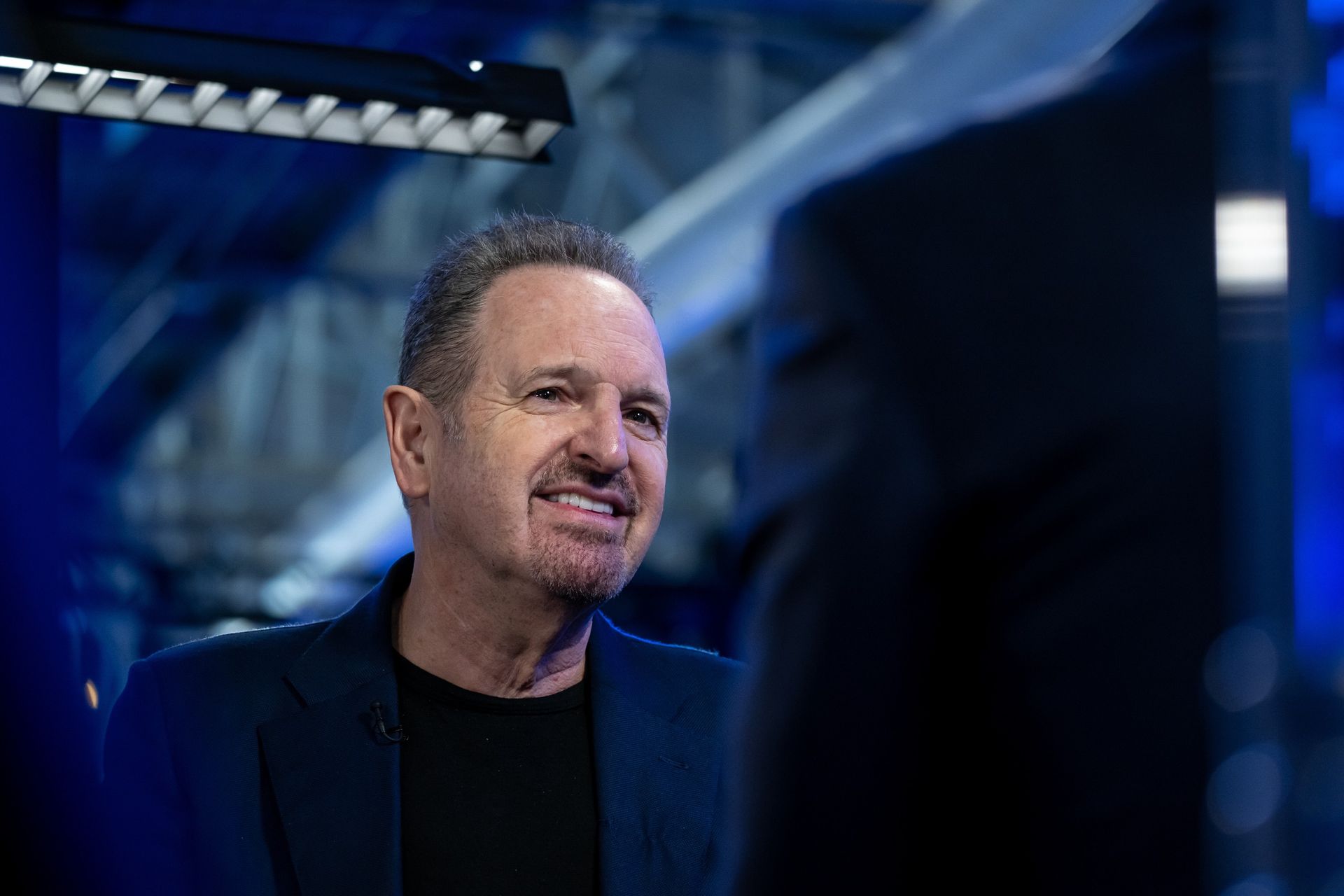
Nvidia's board of directors has approached Arm chief executive Rene Haas as a potential successor to Jensen Huang, according to a report from the Financial Times that cites people familiar with the matter. Haas is among several candidates under consideration, although it remains unclear whether he will get a formal offer and/or agree to take the position.
- The data center cooling state of play
- The custom AI ASIC state of play
- America’s AI chip rules keep changing — and the rest of the world is paying the price
- GTC 2026: Ian Buck press Q&A transcript — VP of Hyperscale and HPC speaks out on shelving CPX and shipping LPU decode this year
- Demand for data center CPUs has surged, and AI agents are responsible
The search for Nvidia's next chief executive comes as the company undergoes a leadership transition following Jensen Huang's swift departure from the CEO position earlier this week. For now, Nvidia's chief financial officer Colette Kress serves as interim CEO. The company's board is currently searching for a permanent replacement and is reportedly evaluating both internal and external candidates. Neither Arm nor Nvidia commented on the matter to FT.
Rene Haas is no stranger to Nvidia, as he spent approximately seven years at the company before leaving in 2013. During his tenure as vice president at Nvidia, he was responsible for multiple projects, including notebook GPUs, Windows-on-Arm, and Tegra system-on-chips. Given that he held senior management positions, he certainly gained experience with Nvidia's operations, corporate culture, and relationships with customers and partners.
Furthermore, Haas has experience with the development of consumer and data center CPUs as well as GPUs and GPU IP, a combination that is hard to find in the industry. Haas reportedly maintains close ties with Jensen Huang and several members of Nvidia's board, which could make him a particularly attractive candidate for a company whose strategy and management structure have orbited around its founder for more than three decades.
While at Arm, Haas has demonstrated a willingness to make substantial strategic changes at the company. Since Haas took the reins in 2022, Arm has introduced its Compute Subsystems (CSS) initiative, providing customers with complete and validated processor platform design, making it easier for newcomers to enter the market. Arm also introduced its first own-brand AGI CPU, putting the company in direct competition with some of its traditional customers. Both initiatives represent significant departures from Arm's traditional business model; however, they demonstrate Haas' readiness to pursue new revenue opportunities despite risks and the possibility of damaging relationships with long-term partners.
Another advantage is Haas' extensive experience with the semiconductor industry in general. Arm's CPU and GPU technologies are used in system-on-chips developed by hundreds of companies that have very distinctive requirements, including Nvidia itself, Apple, Qualcomm, and MediaTek, just to name a few.
In addition, Haas led Arm through its initial public offering in 2023 and therefore has experience with investors and regulators. Also, Haas happens to be the CEO of SoftBank, the parent of Arm.
Nevertheless, Haas' potential appointment would not be without challenges, primarily because he has never managed a company the scale of Nvidia. Arm has around 10,000 employees worldwide; it develops and licenses various semiconductor IP, primarily CPU and GPU technologies, to a wide range of customers with distinct needs. By contrast, Nvidia designs CPUs, GPUs, networking equipment, complete AI systems, and software platforms and has a headcount of about 42,000. As a result, if Haas becomes the boss of Nvidia, he will have to manage a considerably bigger organization with a dramatically more complicated product portfolio and supply chain. Furthermore, replacing Huang, who has led Nvidia since its establishment in 1993 and personally shaped its technology strategy and business tactics, would be a formidable task for virtually any executive.
Ironically, Haas' appointment (if it happens) would create an unusual situation in which Nvidia will be led by the chief executive of a company it attempted to acquire in 2020 and abandoned the transaction in 2022 amid regulatory opposition.


