- Tesla has rolled out a 'Reality Mode' trick in its Full Self Driving v15 update
- It creates a drone footage-style "live visualization" of your car in FSD mode
- It's only available on recent Tesla cars running its latest Hardware 4 tech
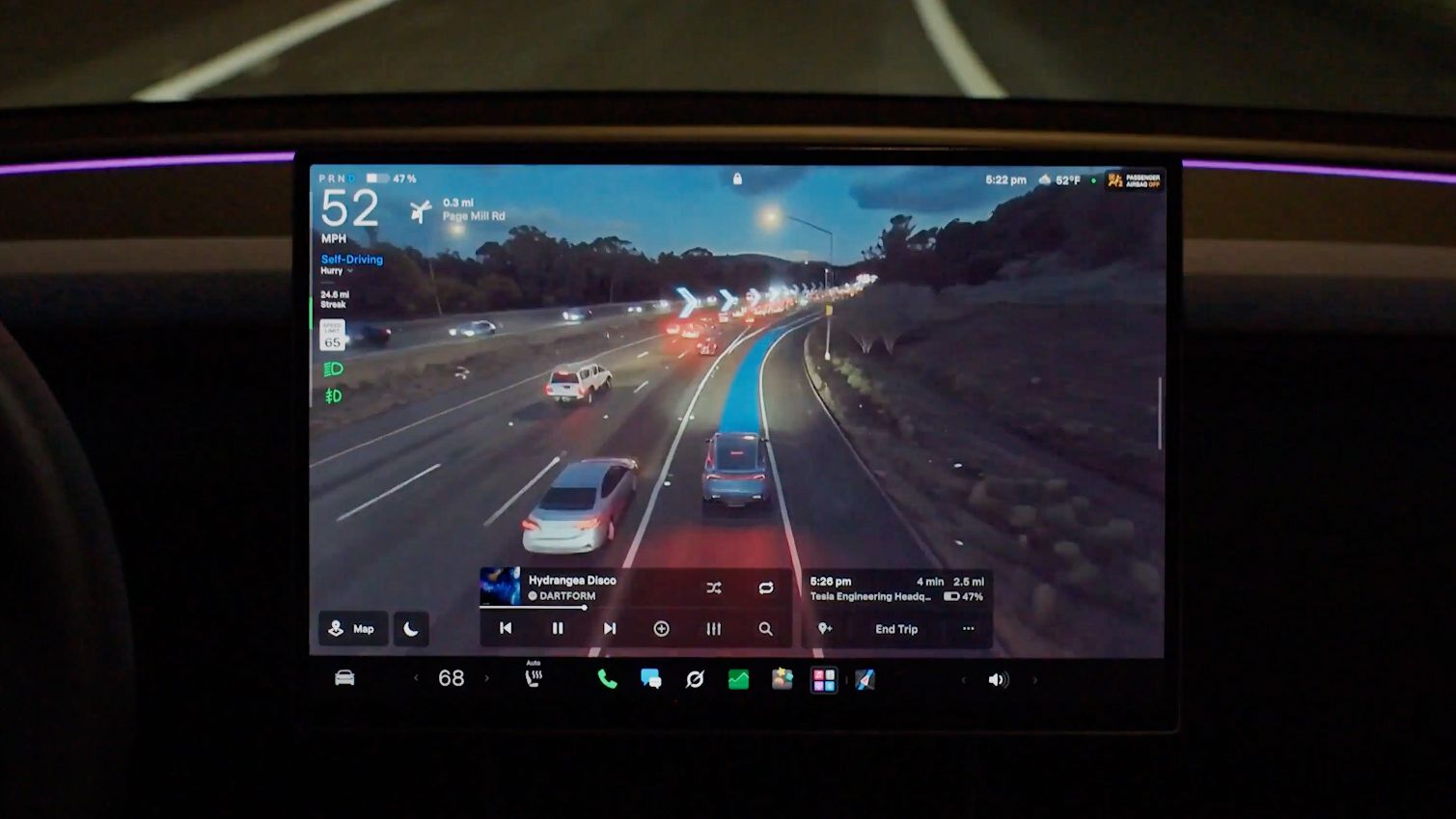
While most of us have spent the weekend speeding around GTA 6 in a Pegassi Vitello, Tesla owners have been trying a wild new in-car mode that has the feel of a video game. Tesla's latest Full Self Driving (FSD) v15 update has delivered 'Reality View', an AI-generated, drone-style view of your car that shows it driving around the real world in FSD mode.
Tesla announced on November 21 that its FSD v15 update was starting to roll out, and over the past two days countless videos have popped up showing Reality View in action. The new mode works by crunching all of the data from the sensors on the latest Tesla cars (those running its latest Hardware 4 architecture) and turning that into an AI-generated view of your car from above.
Reality View isn't generated directly from camera or radar data, but is instead what Tesla calls an AI-generated "live visualization". That's why there's still a lag or around one second between what you can see out of the window and what's on the screen.
Just drove in the rain with FSD V15. Tesla's new Reality View picks up the reflections on the wet roads. https://t.co/fUqXAPYhbXNovember 23, 2026
Still, Reality Mode is an impressive technical achievement. Elon Musk was keen to explain what's going on under the hood in a post on X — Tesla is essentially using a shrunken-down version of one of its world models, and combining that with a diffusion model to create the virtual video feed. Musk claims that Tesla will soon be able to reduce the mode's visual lag by 35%.
This all sounds very impressive, but what's the actual point of Reality Mode? Some have dismissed it as a piece of eye-candy marketing for FSD (albeit one that looks like "GTA 6 in real life"), but others are finding use cases. The main aim seems to be giving you confidence that your car is indeed 'seeing' the world correctly, while graphics like pins, blue lines and chevron arrows show you the car's intentions.
One nice trick is that Reality Mode seemingly lets you choose a parking spot from its arrow pop-ups, although that's unfortunately only an option that appears when driving manually (for now).
Analysis: Tesla hits the gas on autonomous driving
FSD v15 navigating around a tree in the roadNovember 22, 2026
The arrival of Reality Mode comes at a good time for Tesla's automated driving push. It was recently forced to rename FSD to 'Tesla Assisted Driving’ in Europe and the UK, because its 'Full Self Driving' moniker was considered "misleading" by Germany’s Transport Minister, Steffen Bilger.
Critics of Tesla's FSD name have long claimed it creates an impression that drivers don't need to remain attentive while it's engaged, and that it also oversells its capabilities. This has resulted in incidents ranging from drivers who have claimed they shouldn't have received speeding tickets while in FSD mode, to fatal crashes where the tech was reportedly involved.
Reality Mode is a much-needed positive story for FSD, and the tech behind it is undoubtedly impressive — even if it's only available on Tesla cars with the company's latest Hardware 4 brain.
Tesla is also clearly going hard on autonomous driving, from its $3.3bn Cybercab push in Germany to its robotaxi going on sale for "personal use" (albeit with major restrictions). Elon Musk has even claimed that all Tesla cars will get an embedded Starlink option "towards the end of next year", to help boost their unsupervised FSD driving powers.