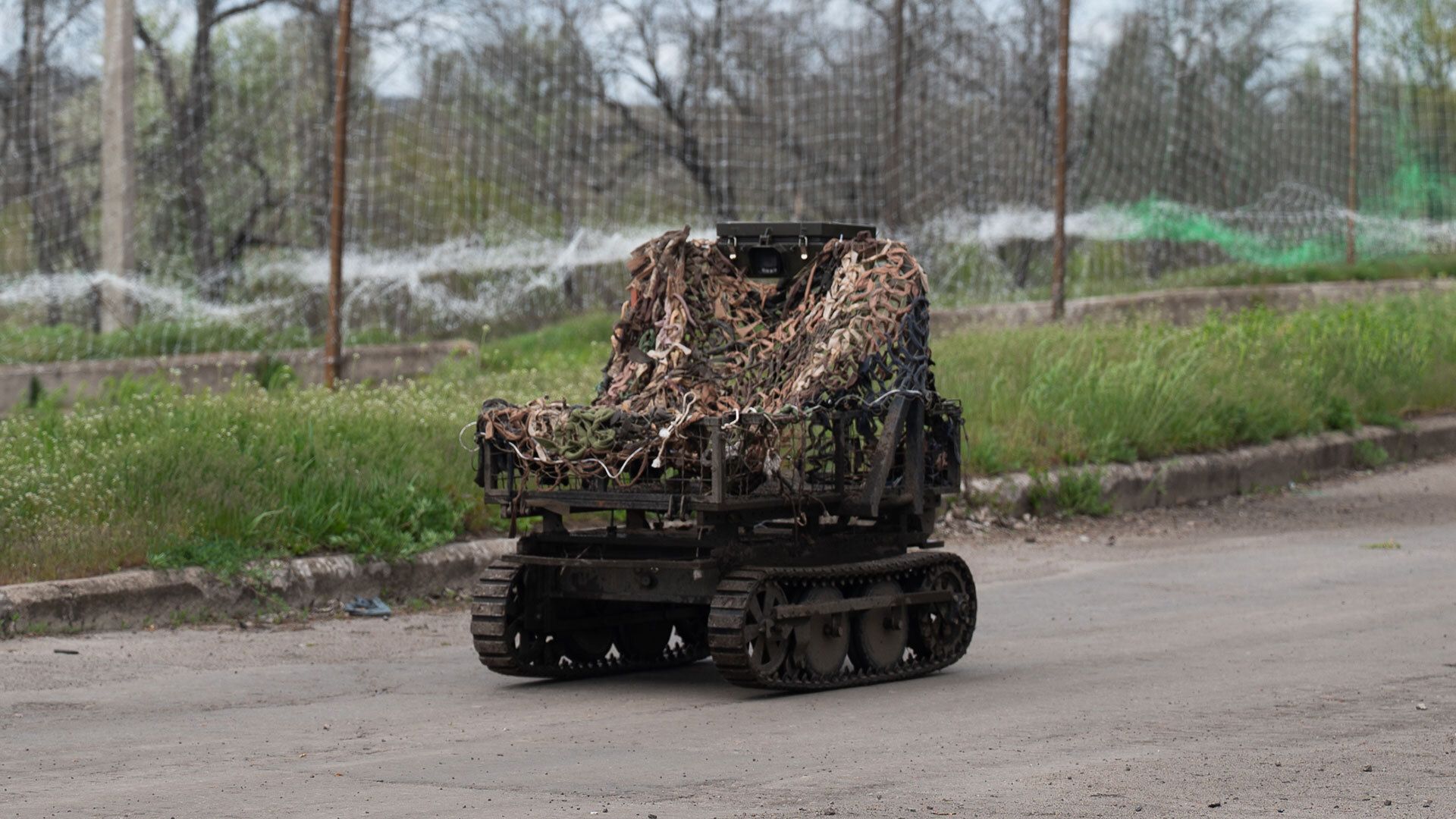
Ukraine is developing a new class of combat robots designed to operate inside underground gas pipelines, where Russian troops have repeatedly attempted to bypass frontline defenses, United24Media reports. The project, disclosed by Ukraine's 2nd National Guard Corps, Khartiia, involves modifying unmanned ground vehicles (UGVs) to perform reconnaissance and combat missions in spaces too narrow for conventional military machinery. Notably, the work is being carried out by specialists from the corps’ Lava Unmanned Systems Regiment, following Operation Veles — an underground assault that saw Ukrainian soldiers advance more than 15 kilometers through pipeline infrastructure near Kupiansk. Khartiia says the operation killed more than 100 enemy soldiers and resulted in over 30 captured, although those battlefield figures have not been independently verified.
The commander of Lavas ground robotic system battalion, identified by the callsign ‘Matematyk’, said the project addresses a category of warfare that requires a different approach from conventional battlefield robotics. “There is a very long list of tasks that need to be accomplished to fight underground and counter the enemy underground. This is a new class of technologies and challenges that we will have to confront,” he said.
The machines are being adapted from existing groundrobots,rather than developed as conventional surface vehicles. They must be compact enough to navigate narrow pipelines while retaining the ability to carry out military assignments . Most commercially available underground machinery, meanwhile, is designed for construction, drilling, and tunneling — not combat.
As of now, Khartiia is already developing several robotic systems to address those limitations, with the broader objective of sending machines into dangerous underground environments where soldiers would otherwise have to conduct reconnaissance, confront enemy positions, clear positions, or clear out themselves. “War is already underground, and it will expand. The question is how we adapt to this war,” Matematyk said.
The project follows unusual battlefield developments near Kupiansk, where Ukrainian forces used the same underground infrastructure that Russian troops have previously exploited to infiltrate behind Ukrainian defensive positions. During Operation Vels, Ukrainian soldiers moved through a gas pipeline measuring approximately 1.2 meters in diameter, according to a report by Ikrainska Pravda. The confined passage made movement and close-range firefights particularly,with Ukrainian troops having little-to-no room to maneuver.
Russia had previously used the pipeline network beneath the Oskil River to move soldiers toward Ukrainian-held territory. The Ukrainian battlefield monitoring group ‘Deepstate' reported an earlier Russian infiltration attempt in September 2025. Last month, President Volodymyr Zelenskyy said that Ukrainian forces had eliminated more than 100 Russian troops and captured over 30 during the operation. The experience also exposed the limitation of sending soldiers into such environments. Underground operations restrict visibility,complicate communications , and leave little room for maneuvering equipment.
That said, Ukraine has increased its reliance on unmanned military systems as battlefield terrain proves complicated to navigate. In July 2024, we reported on Ukrainian forces deploying AI-controlled drones capable of independently identifying and attaching targets. The country has also been experimenting with unmanned systems that operate beyond conventional aerial platforms. In August, the US Army tested an autonomous Ford F-250 breaching vehicle, which builds on the Lancer unmanned ground vehicle program and uses a counter-drone turret to protect military operations from aerial attacks.
However, autonomous ground systems still face considerable technical challenges. Russia's Shturm uncrewed assault tanks , for instance , repeatedly lost their command connection during the Tsentr-2026 military exercise. The vehicle eventually became stuck in mud, even after organizers switched to manual driving. Russia has also tested an AI powered Shahed variant using Nvidia's Jetson Orin computing platform. The system was reportedly capable of identifying targets without relying on externally supplied coordinates.


