Backend
AAC: Admissible-by-Architecture Differentiable Landmark Compression for ALT
arXiv cs.RO0 views
arXiv:2604.20744v3 Announce Type: replace-cross Abstract: We introduce the Architecturally Admissible Compressor (AAC), which adapts landmark-based A* heuristics to query demand under a fixed label-memory budget. AAC provides two continuous relaxations of ALT (A*, Landmarks, and Triangle inequality) selection. With exact landmark distances, every parameter value defines a lower bound on shortest-path distance. Both relaxations deploy ALT using only the selected labels. The row-stochastic relaxation takes convex combinations of landmark distances. We characterize the maximal admissibility-preserving linear classes and prove that the relaxed and discrete optima coincide. The fractional relaxation mixes subset heuristics and supports continuous greedy (AAC-CG) with exact gradients and an entropy-regularized oracle for differentiable selection. For expected heuristic value, we prove an approximation guarantee with finite-step, oracle-error, and finite-sample terms. The limiting $1-1/e$ factor is optimal for arbitrary supplied pools and query distributions unless P${=}$NP. At matched label memory, AAC-CG reduces A* expansions by $1.9$-$22.7$% relative to farthest-point ALT (FPS-ALT) in all $19$ tested combinations of graph and memory budget across six road networks and two synthetic graphs. Each combination uses one $500$-query test split; all methods share distance tables when distances are symmetric. Canonical greedy also expands fewer nodes than FPS-ALT in all $19$ graph-budget pairs. AAC-CG achieves $99.6$% of canonical greedy's mean heuristic value on test queries, averaged over these pairs. AAC makes admissibility independent of training success, while its analysis and experiments distinguish selection quality from search efficiency.
Source:https://arxiv.org/abs/2604.20744PreviousDynamic Multi-Robot Task Allocation under Uncertainty and Communication Constraints: A Game-Theoretic ApproachNextDeformMaster: An Interactive Physics-Neural World Model for Deformable Objects from Videos
Related posts

Introducing workload recovery and expanded infrastructure checks on Amazon SageMaker HyperPod
0AWS Machine Learning Blog
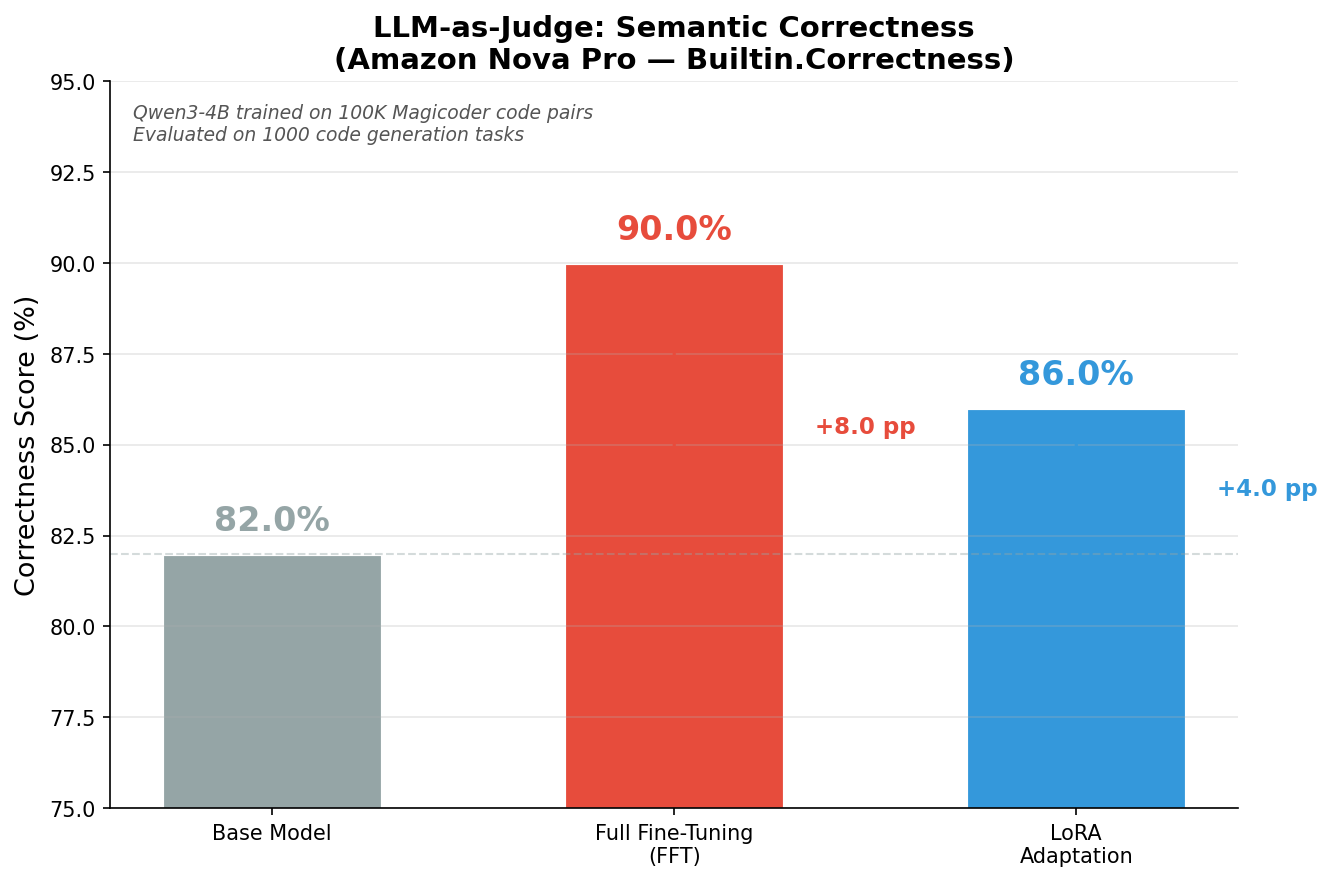
Full Fine-Tuning (FFT) on SageMaker AI Serverless Model Customization
0AWS Machine Learning Blog

Observer-Assisted Relative-Velocity Compensation with LPV-$H_\infty$ Robust Correction for 3D Trajectory Tracking of Underactuated Non-Minimum-Phase AUVs under Ocean Currents
0arXiv cs.RO

Long-Term Multi-Session 3D Reconstruction Under Substantial Appearance Change
0arXiv cs.RO

Why Self-Review Fails in AI Coding Agents: Single-Agent Self-Review vs. an Adversarial Critic (0% vs. 100% Mutant Kill Rate)
0dev.to AI

From Prototype to Production: Building AI Agents with the Claude Platform on Google Cloud
0dev.to AI