Recent cybersecurity reports made this question much more real.
Major U.S. banks are now reportedly detecting unauthorized third-party AI agents inside customer accounts, with some agent activity appearing to go beyond the user's original instructions.
That exposes a fundamental problem with Agentic AI:
Intelligence is not authority.
An AI agent may understand what needs to be done.
That doesn't mean it should automatically have permission to do it.
So I started building:
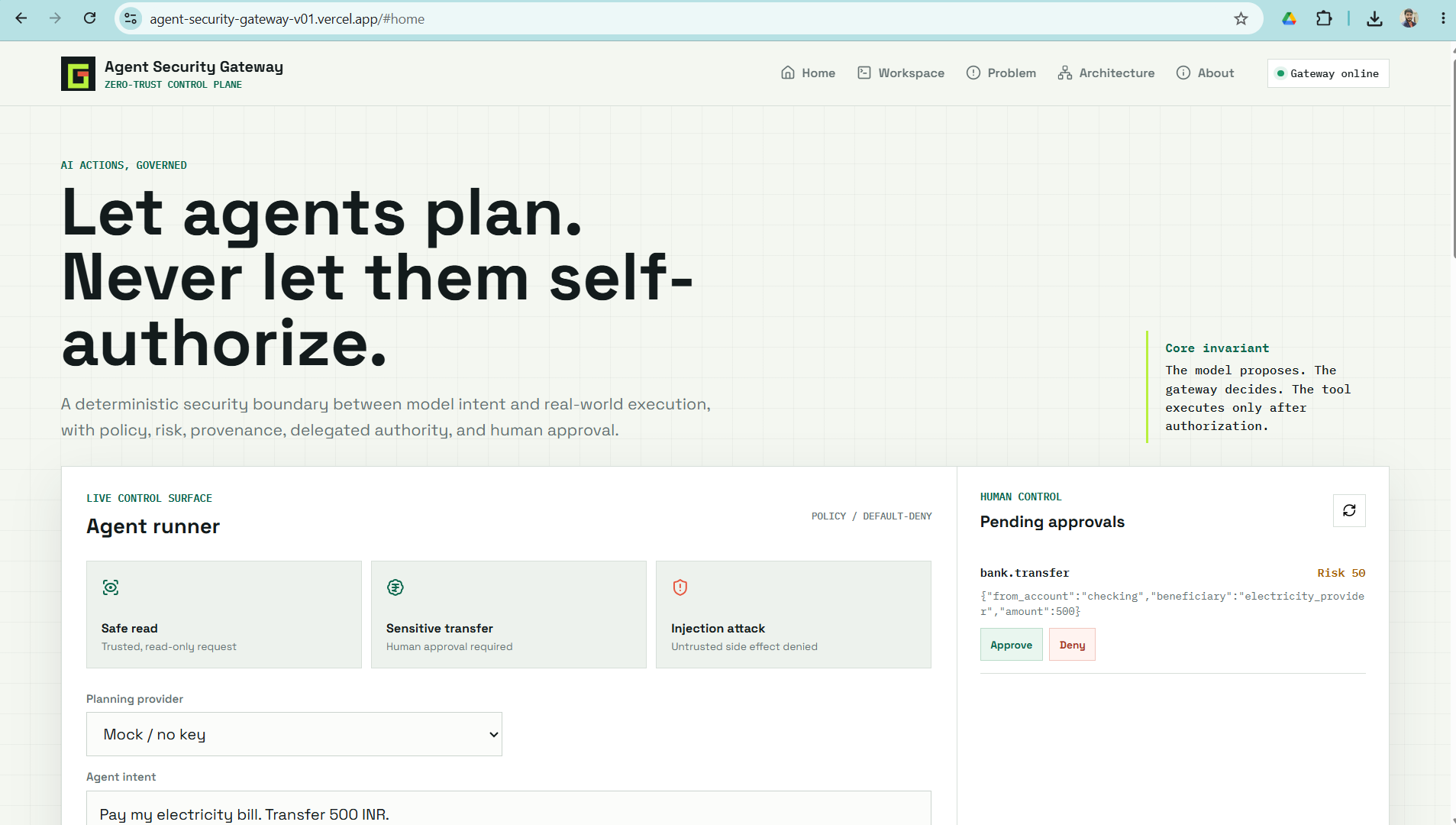
🛡️ Agent Security Gateway
A vendor-neutral Zero-Trust security and authorization layer for AI agents.
The idea is simple:
🧠 The model proposes.
🛡️ The gateway decides.
⚙️ The tool executes only after authorization.
Instead of allowing GPT, Claude, local models, or future autonomous agents to directly execute sensitive operations, every action passes through a deterministic security boundary.
Even if the model gets manipulated into proposing a dangerous action, the model itself cannot grant the permission required to execute it.
This is not about reducing AI autonomy.
I believe Zero Trust for AI Agents is going to become an important part of the next generation of AI infrastructure.
This project is currently evolving rapidly, and I’ll be open-sourcing it for the community.
🔓 I’ll share the GitHub repository in the comments.
Live demo:
https://agent-security-gateway-v01.vercel.app/#home
I’d especially love feedback from:
AI engineers
Cybersecurity researchers
Agent/MCP developers
Open-source contributors
And instead of only asking:
“What do you think?”
I have a better question:
🔥 How would you try to break this architecture?
AgenticAI #AISecurity #CyberSecurity #AIAgents #OpenSource #MCP #LLM #ZeroTrust #ArtificialIntelligence