
Somewhere in your company's ServiceNow instance is the answer to the question an engineer asks at two in the morning: if this is broken, what else is about to break?
Every fact needed to answer it has already been written down, correctly, by somebody doing their job properly. Getting it out still takes twenty minutes of opening one record at a time, and at the end you can't be sure the list is complete.
This book is about closing that gap, and about measuring whether it really closes.
You'll take a free ServiceNow developer instance, load a company's worth of servers, services, incidents, changes, problems, and knowledge into it, and read it back out with Python.
Next, you'll model that estate as a graph, load it into Neo4j, and build eight different ways of choosing which records to put in front of a language model.
Then you'll score all eight against thirty nine questions. I wrote and hashed those questions before any of the retrieval code existed, so nothing in the book could be tuned to them.
Here's what you'll have at the end:
Your own ServiceNow instance holding 11,891 configuration items and 68,900 tickets.
The same estate as a Neo4j graph, with 28,694 dependency edges.
Eight retrieval methods you built yourself, from plain keyword search to a walk through the graph.
A language model answering from that retrieval, on a GPU you control, so the ticket text never leaves it.
A results table saying which method actually found the right records, and a list of the fourteen things that table can't tell you.
And here's what you'll learn along the way:
What a graph database is for, and when it beats a relational one.
How ServiceNow's CMDB stores dependencies, and why that makes a three hop question expensive.
What retrieval means, and why it decides how good every answer is.
How to build a comparison that could have proved you wrong.
This isn't a victory lap. The question the book opens with is one that none of the eight methods answered, and Part 10 reports that with numbers instead of hiding it.
You'll finish with a working system, and a real account of where it falls down. That's worth more than a demo that only ever gets asked the question it was built for.
This book is free, start to finish. Every account it uses has a free tier, and the single rented GPU in Part 8 is priced in section 7 before you spend anything.
Table of Contents
Part 0: The Problem, and Why a Graph Solves it
Part 4: Loading it into ServiceNow
Part 6: Modeling ServiceNow as a Graph
-
Part 8: Running Your Own Model on Your Own GPU
Before You Start
What You Need to Know:
You'll need enough Python to read a script and run it: a for loop, a function call, a dictionary. You'll be reading and running the code in this book, not writing a framework. And you'll need enough knowledge of the command line to change directories, run a script, and read an error message.
You don't need ServiceNow experience. Part 1 creates a free developer instance, and Part 3 explains every table before anything is loaded into it.
You don't need Neo4j or Cypher either. Parts 6 and 7 teach both from nothing, and we'll define every term just below, before you meet it.
Finally, you don't need a machine learning background. Parts 8 and 9 explain embeddings, tokens, and retrieval in plain English as they arrive.
What You Do Need:
This table covers what you will need to follow along:
| what | where you set it up | what it costs |
|---|---|---|
| Python 3.10 or newer | section 22 | free |
| A ServiceNow developer instance | section 11 | free |
| Neo4j, either Aura's free tier or Docker | section 67 | free |
| A GPU for one afternoon | Part 8 | about $5, priced in section 7 |
The GPU is the only thing here that costs money, and Part 8 is skippable. Section 19b lists the ways out of it. The measurements in Part 10 don't change if you use a hosted model instead, because retrieval happens before the model is involved.
Part 0: The Problem, and Why a Graph Solves it
1. A Question Nobody Can Answer Quickly
The time is 02:10. The payments service is failing.
You're the engineer on call. Before you can fix anything, you need to know one thing: what else is about to break?
The answer exists. It's sitting in ServiceNow right now.
Somebody recorded that the payments service runs on an application. Somebody else recorded that the application uses a database. A third person recorded which storage array that database sits on.
Every one of those facts was entered correctly, by a real person, doing their job properly.
None of that helps you at 02:10.
To get your answer, you open the payments service record. You read its dependencies. You open each one. You read its dependencies. You open each of those.
Twenty minutes later you have a list on a notepad. You're not sure it's complete. The incident is still open.
Here's what that walk is worth, on the estate this book ships with. An estate is everything a company owns and runs: its servers, services, and databases. This one holds 11,891 of them.
Ask it upward first, meaning what stops working if payments stops. The answer is 16 items. Only 2 of those 16 appear on the payments service record itself. The other 14 are further away, each one reached by opening another record, and then another.
Now ask it downward, meaning what underneath could be causing this. The payments service runs on an application called app0958. That application uses a database called pg0711. That database sits on a storage array called san-eu-west-01.
That storage array carries 512 databases, belonging to 15 different teams: billing, catalogue, checkout, fraud, identity, inventory, loyalty, notifications, onboarding, payments, pricing, reporting, search, settlement, and shipping.
So the real question at 02:10 isn't really about payments at all. Are you looking at one broken service? Or at the first symptom of something underneath that's about to stop 15 teams working?
The records needed to answer that are all in ServiceNow. The array is three hops away. A hop is one step from a record to the record it points at. Three hops means four records to open, one after another. Each one tells you only where to look next. Nothing on the payments service record tells you the array exists.
That's the problem this book takes on. Nobody caused it by doing anything wrong, and section 2 says what does cause it.
The Three Tools, and What Each One Does
Three tools sit between that problem and an answer, and they each do one job.
ServiceNow is where the facts already are. Most companies use it to run IT. Every server, service, and database is a row in it. Every ticket is a row. Every dependency between two items is a row too. Nothing has to be collected. It's already written down.
Neo4j is a graph database. It stores the same facts as circles joined by named arrows. In a graph the connections are the data, not something you rebuild every time you ask. Following an arrow costs the same whether you follow one or twenty. That's why three hops stops being a twenty minute job.
GraphRAG is the last step. You ask in plain English. The graph picks which records matter. Those records go to a language model, and it writes the answer from them. The R in RAG is retrieval, which means choosing what to show the model. Choosing well is what most of this book is about.
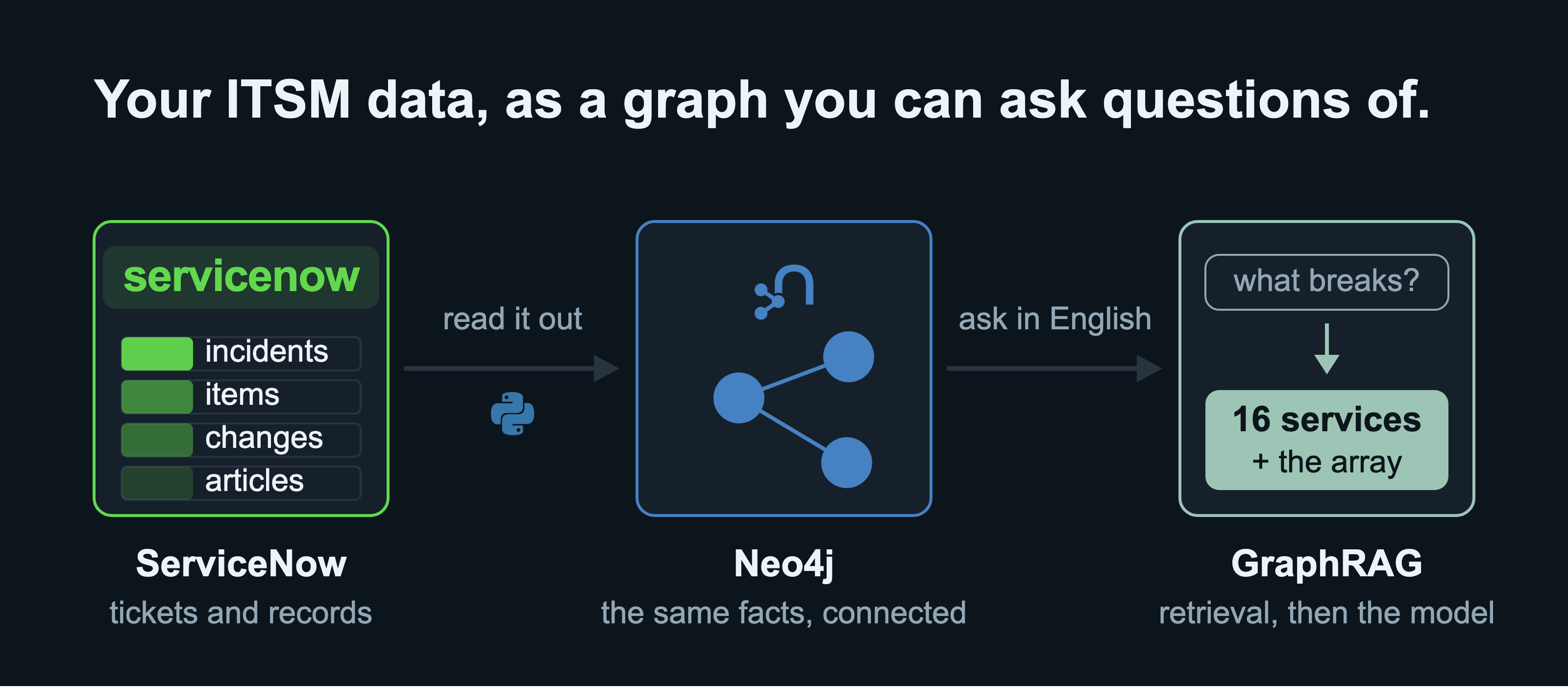
That's the whole book in one picture. On the left your facts sit in ServiceNow, one row each. Those aren't only configuration items: the book reads 60,000 incidents against 11,891 items, and it reads changes, problems and knowledge articles too. In the middle they become a graph in Neo4j. On the right you ask in plain English, and the answer is built from whatever the retrieval found.
Parts 1 to 7 build the left and the middle. Parts 8 to 10 build the right, and Part 10 measures how often the retrieval returned the right thing.
I want to be straightforward with you about the ending, here at the start. We'll build the whole thing. The records come out of ServiceNow and the graph goes up. We'll write and measure eight different ways of choosing what to show a model. Ask the graph this question directly and it answers in milliseconds. Part 7 shows exactly that.
The step in between is what doesn't work yet. That's where a sentence in English has to become the right question for the graph. On this estate, with the questions frozen before the graph existed, not one of those eight ways answered the 02:10 question. Part 10 section 108b reports that zero alongside everything else.
So read this as a build and a measurement, not a victory lap. You'll finish with a working system and an honest account of where it falls down. That's worth more than a demo that only ever gets asked the question it was built for.
What's Real Here, and What's Written
Every number in this book comes from one dataset, and it ships with the code. Part 3 walks through it file by file before you load any of it. Before you read another number, you should know which of them describe a real thing.
Start with the real half. The ServiceNow instance is real: you create it yourself, and it's free. So are the tables, the fields, and the API. So is the field behaviour, including the parts the documentation doesn't mention. So are the identification engine, the business rules, and the rate limits. And so is every measurement in this book, taken on that instance and on this data.
The written half is the estate itself. There's no company with these servers. The words inside the tickets are written too, every short description, every work note, and every resolution.
They have to be written, and the reason is worth one paragraph. An incident's work notes contain hostnames, internal service names, customer names, and sometimes credentials pasted by an engineer in a hurry. It's some of the most sensitive text an organisation holds, and no company will ever publish it. That's why every public dataset in this space is either tiny or invented.
It's also the reason this book runs its own model rather than calling a hosted API. If the text is the sensitive part, sending it to somebody else's service is exactly what a security review refuses.
The dataset is generated by a seeded script that ships with the book.
The Words You'll Need, Before You Meet Them
Seventeen words carry the whole book. Here's each one in plain English, before anything below depends on it. Read it once now, and return to it whenever a word stops meaning something.
A node is one thing, like a server, a service, or a ticket. It's drawn as one circle.
A label is the graph's own name for what kind of thing a node is, like
ServerorIncident. One node can carry more than one.A relationship is a connection between two nodes, with a direction and a name. "This application runs on that server" is drawn as one arrow between two circles.
A property is a fact stored on a node or a relationship, like a server's name or a ticket's priority.
A graph is nodes and relationships together. That's the whole idea. What makes it useful is that following a relationship costs the same whether you follow one or twenty.
Cypher is the language you'll use to ask a Neo4j graph a question. It's built around drawing the shape you want in text, and it looks more like a picture than like SQL.
CMDB stands for Configuration Management Database. It's the part of ServiceNow that records what you own and how it's connected.
CI stands for Configuration Item. It's one thing in the CMDB, like a server, a database, or a service.
LLM stands for Large Language Model. It's the thing that reads records and writes an answer in English.
vLLM is a program that runs an LLM on a GPU you control and answers requests over HTTP, the way a web server answers requests for pages. Part 8 uses it so the words inside your tickets never leave a machine you rent.
A token is how a model counts text. It's roughly four characters, so about three quarters of a word. It matters because a model can only read so many tokens at once. That limit forces every decision later.
A chunk is one piece of text, cut to a size worth storing and retrieving. It can be a whole ticket, or one field of it.
An embedding is a list of numbers standing for the meaning of a chunk. Two chunks that mean similar things get similar numbers. That lets a computer find text by meaning instead of by exact words.
A vector index is a store of embeddings, built so you can ask "what is closest in meaning to this?" and get an answer quickly.
The sys_id is ServiceNow's own identifier for a record: a 32 character string it generates and never shows you unless you ask. It isn't
INC0010001. That's the number a human reads, and thesys_idis what every reference between two records actually stores. From Part 4 onwards, this is the difference between a link that works and a blank field that never errors.Retrieval is choosing which records to show the model. The whole book is about this one concept.
RAG stands for Retrieval Augmented Generation. Find the relevant records, put them in front of the model, and let it answer from them. GraphRAG is the same idea where a graph decides what is relevant.
Those seventeen terms aren't seventeen separate facts. They're three short chains, and each one is easier to hold as a picture than as a list. Let's see how they fit together visually in the following diagrams:
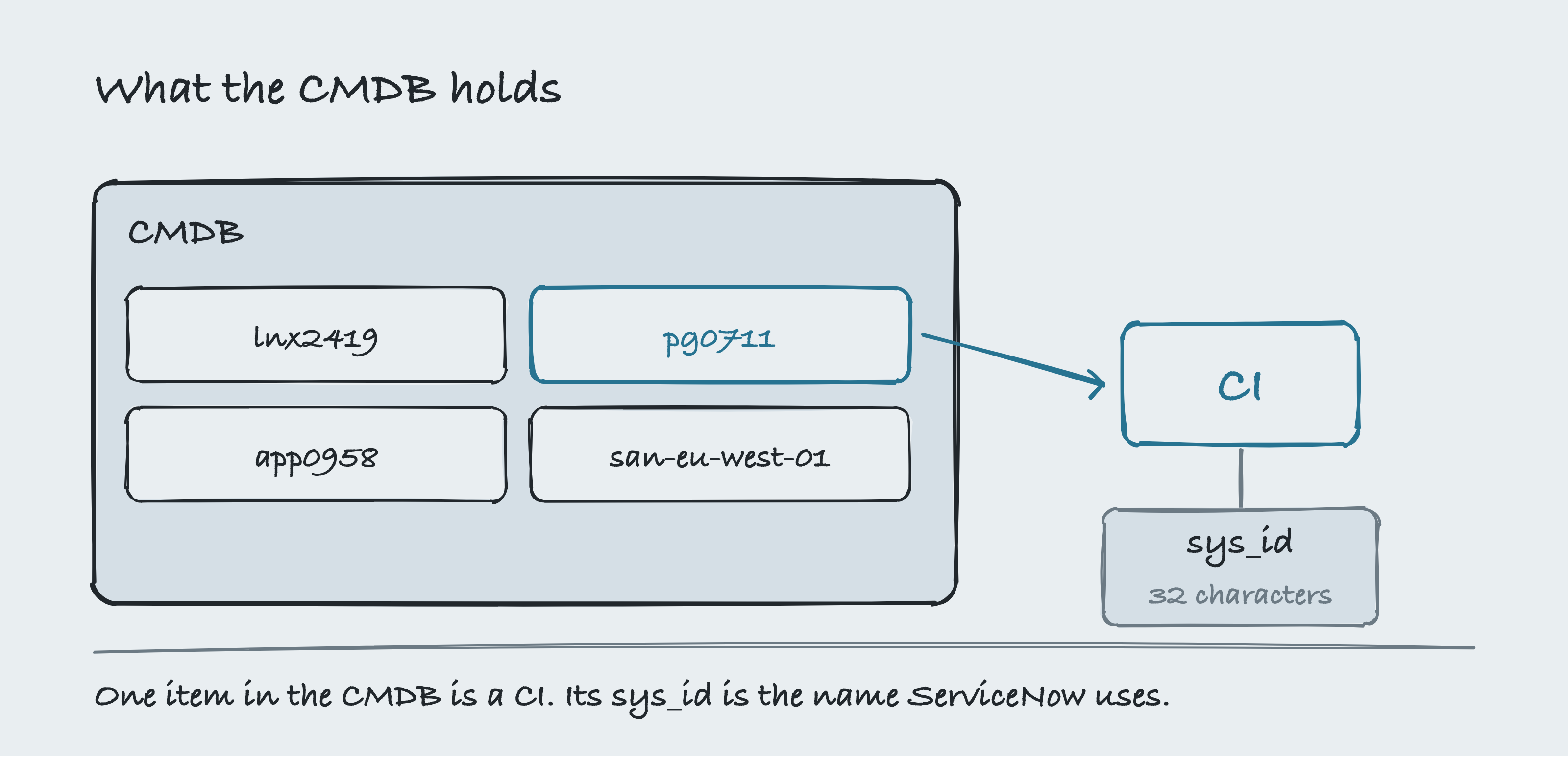
Three words, one inside the other. The CMDB is the list of everything you own. One line on that list is a CI, and pg0711 above is one. The sys_id is the 32 character name ServiceNow generates for that line and never shows you unless you ask. From Part 4 onwards the sys_id is the difference between a link that works and a blank field that never errors.
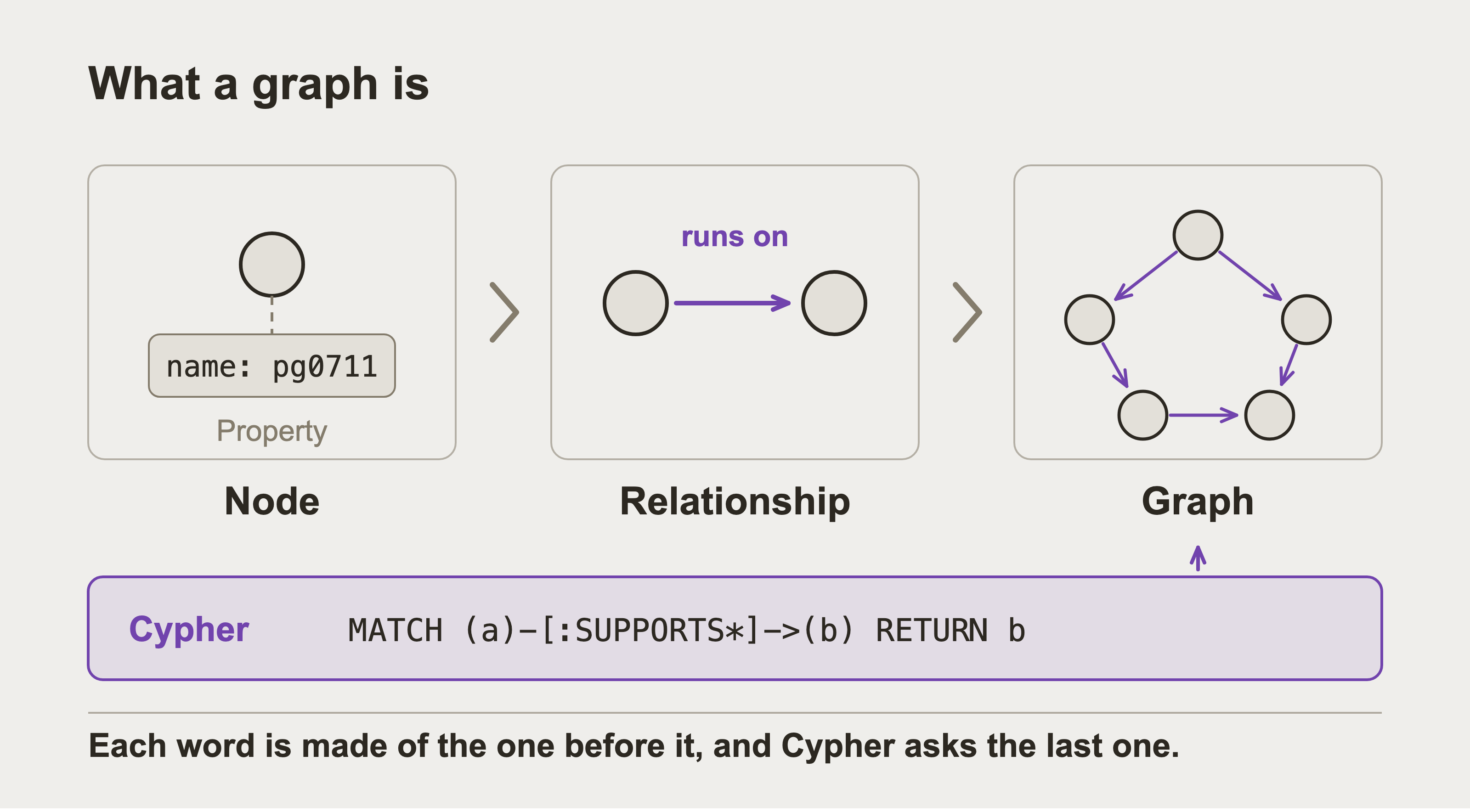
Each word here is made of the one before it. One circle is a node. A named arrow between two of them is a relationship. Enough of those together is a graph. A fact stored on a node, like the name hanging off the first circle, is a property, and relationships carry properties too. Cypher is the language you use to ask the finished graph a question.
The line in the band is a real one. It says follow SUPPORTS as far as it goes, and hand back everything you reach.
Here are five of those words again on one real record out of this book's own data, so you have seen each one on a thing rather than in a sentence.
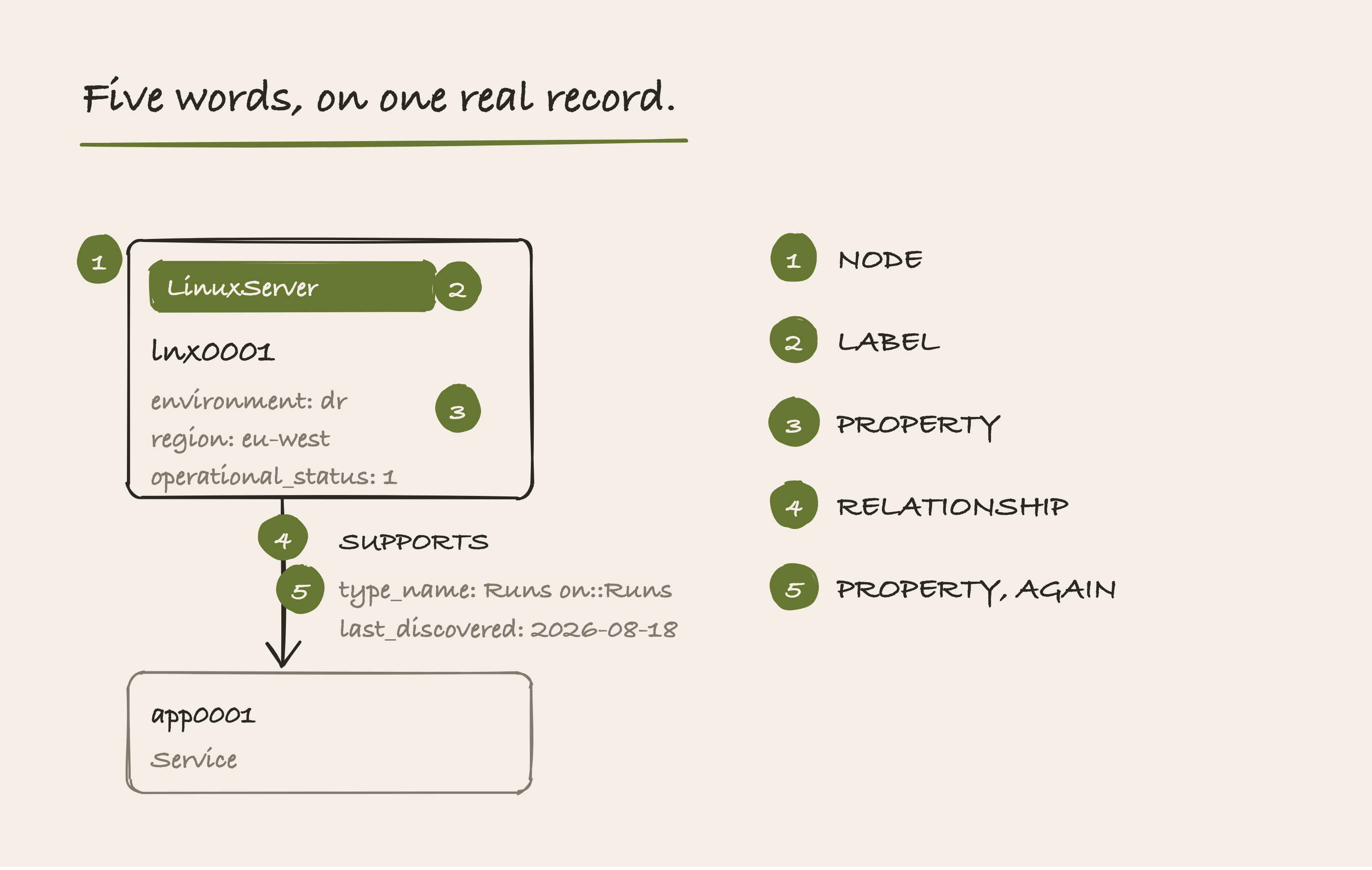
Five words, on one real record. The box is a node. The chip is its label, which is the graph's own name for what kind of thing this is. LinuxServer is the label Part 7 applies, not the ServiceNow class the row arrived under. Each line inside the box is a property. The arrow is a relationship, which is named and has a direction. And the arrow carries properties of its own.
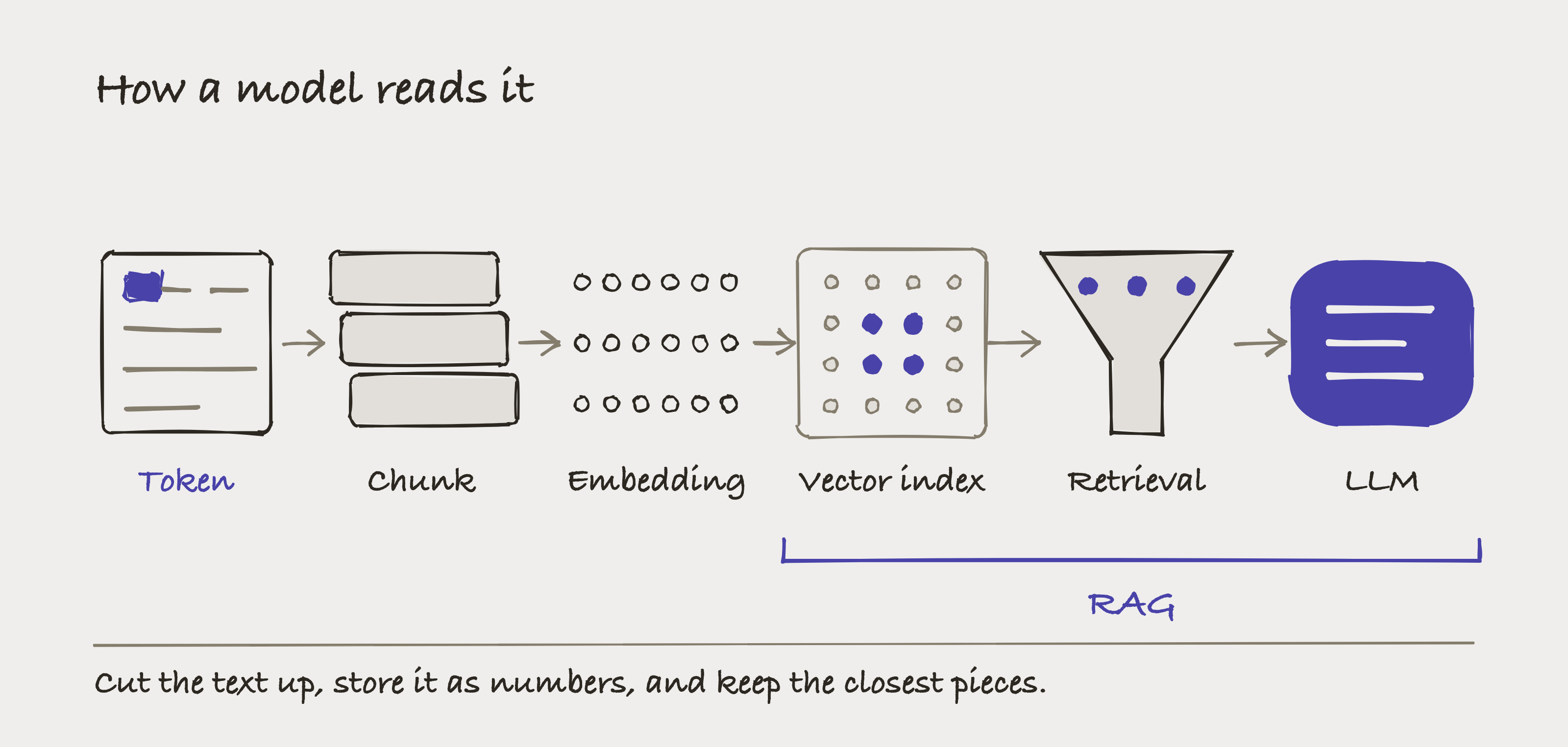
The other seven words are one journey a piece of text takes. A token is how the model counts that text, roughly four characters. A chunk is one piece of it, cut to a size worth storing. An embedding is that chunk written as a list of numbers. Two pieces that mean similar things get similar numbers. A vector index holds those numbers so you can ask what is closest. Retrieval is the narrowing, choosing which few pieces the model actually sees. The LLM reads them and writes the answer, and the whole of the last stretch is what people mean by RAG.
Three more belong to Part 10, and this part already uses them.
Recall is the share of the records a correct answer needs that actually came back. 1.00 is every one of them. 0.00 is none.
An arm is one retrieval method, measured against the others. A drug trial has arms, and so does this comparison. Part 10 scores eight.
A holdout is a question kept back while the system is being designed. It tests the finished thing, rather than being the thing the design was tuned against.
The Route, Part by Part
The introduction said what you'll have at the end. This is the route to it.
There are ten parts after this one, and each finishes something you can check on your own screen before the next one starts.
One thing to expect before you start: the scoreboard at the end doesn't crown a winner, and section 111 explains why that's the useful result rather than a disappointing one.
Here's the whole route on one page. Every part is safe to stop after, so this is a weekend project you can put down.
| Part | What you do | What you have when it is done | Time (Estimated) |
|---|---|---|---|
| 1 | Create three free accounts and put every key in one file | Credentials that work, proved with a 200 | 40 min, plus one wait |
| 2 | Set up Python and clone the code | One script that connects to everything and prints ok | 15 min |
| 3 | Look at the dataset before loading it | The row counts you'll check every later number against | 15 min |
| 4 | Load the estate into ServiceNow | 11,891 items and 68,900 tickets in a real instance | 60 min, mostly waiting |
| 5 | Read it back out with Python | Records in memory, with the field traps handled | 40 min |
| 6 | Decide what the graph should look like | A model you can defend, drawn before any code | 60 min reading |
| 7 | Load the graph into Neo4j | A graph you can walk, checked four ways | 30 min |
| 8 | Rent one GPU and serve two models | A language model answering on hardware you control | 45 min, billing |
| 9 | Build five ways to retrieve | Five retrievers, which Part 10 scores alongside three plain baselines | 90 min |
| 10 | Score all eight against frozen questions | A measured table, and an honest account of where every arm failed | 60 min |
There are two things this book won't do. It won't tell you graphs are always better, because Part 10 measures a question where they are not. And it won't ask you for a payment card until Part 8, which is the only part that costs anything.
2. Why This is Hard in ServiceNow Today
Section 1 ended with twenty minutes, a notepad, and a list you can't be sure of. It would be easy to blame ServiceNow for that, and it would be wrong.
The twenty minutes aren't a bug, a missing feature, or somebody's failure to fill a field in. They fall out of one design decision at the centre of the CMDB, and that decision is the right one for almost everything else the platform does. This section is what that decision is, and why it costs you twenty minutes at 02:10.
A CMDB stores each fact as its own row. The payments service is one row. The application is another row. The sentence "the payments service depends on this application" is a third row, in a table called cmdb_rel_ci, holding a parent, a child, and a type.
The design is a good one. It means any two items can be connected without changing the shape of the database.
The cost of that design appears when you ask a question whose parts live in more than one row.
The rest of this section rests on one term, so take that first. A join is how a relational database answers a question like that. You tell it: take this row, find the row its child column points at, and hand me both together. Writing one join is ordinary work. The trouble starts when you don't know how many you need.
Count them for the 02:10 question. "What depends on the payments service?" is one row and no join at all. "What depends on what depends on it?" needs one join, because the first row's child has to become the second row's parent. Three deep needs two joins. And "everything that breaks if this breaks" needs a number of joins nobody can write down in advance. The chain stops when it stops, and the only way to learn where is to walk it.
When a table joins back to itself like this, once per step, it's called a self join. Each extra step is another one somebody writes by hand.
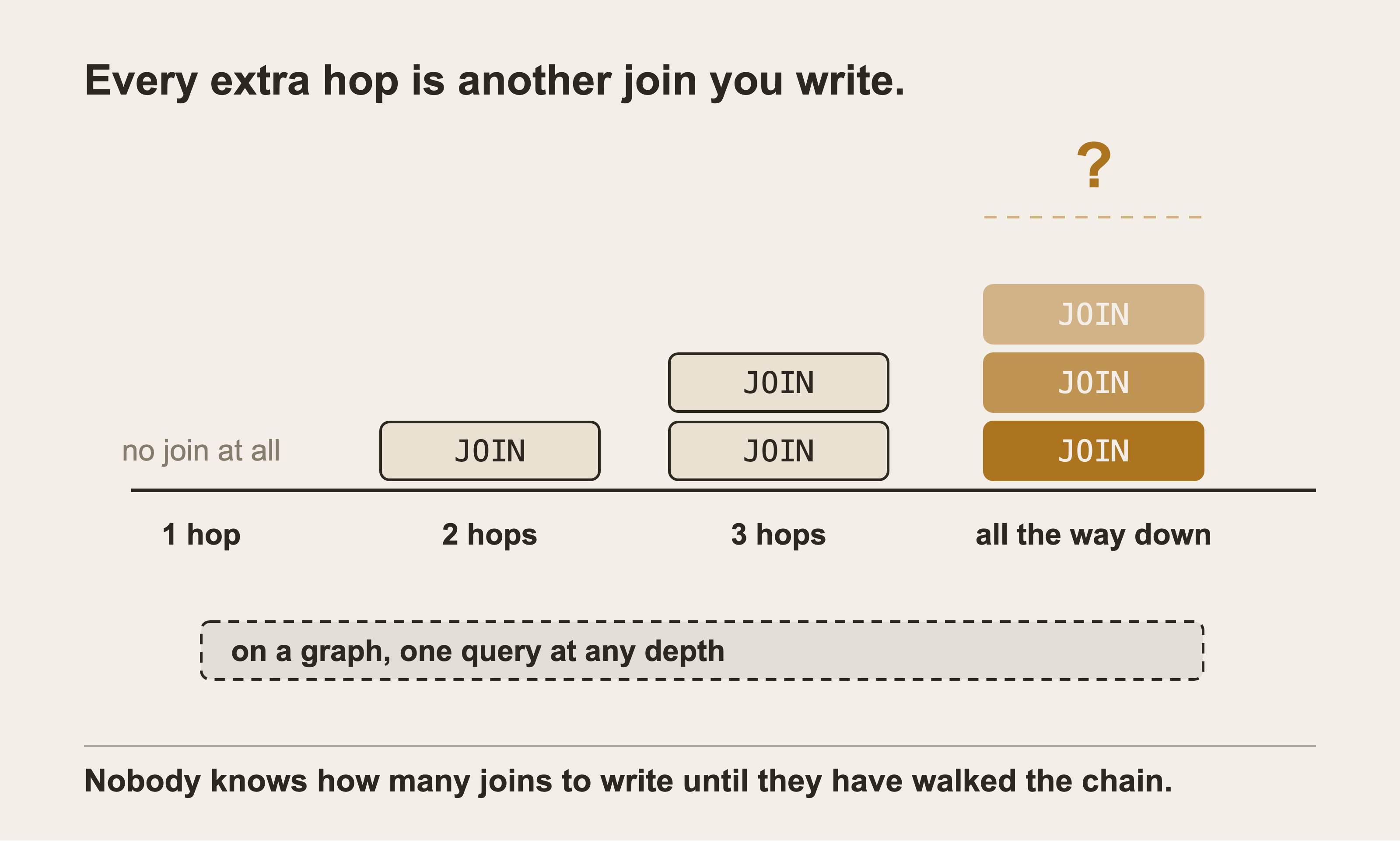
Count the tiles. One hop needs no join at all. Two hops needs one, three hops needs two, and each of those is a line somebody types. The fourth column is the real question and it has no top. The number of joins is whatever the chain turns out to be.
That's the problem, and it's not that the query would be slow. Nobody can even write it until they have already walked the chain by hand, which is the twenty minutes with the notepad. The slab underneath is the graph version: one query, and it doesn't change when the chain does.
Here's that three hop column written out. This is SQL, and it's correct, and it runs:
SELECT c.child FROM cmdb_rel_ci a JOIN cmdb_rel_ci b ON b.parent = a.child JOIN cmdb_rel_ci c ON c.parent = b.child WHERE a.parent = :item Read the two JOIN lines and you can see the table being joined back to itself, once per hop. Three hops, two joins, and a fourth hop would need a third.
Here's the same question in Cypher, which is the language Neo4j takes:
MATCH (a)<-[:SUPPORTS*]-(b) WHERE a.key = $item RETURN b The * is the whole difference: it means follow this relationship as far as it goes. Nothing in that line says how deep. So nothing has to change when the answer is four levels down instead of three.
Here is the objection a reader who knows SQL is already making, and it's a fair one. Standard SQL can walk a chain of unknown length. WITH RECURSIVE has been in the standard since SQL:1999, and Postgres, MySQL, Oracle and SQL Server all have it. One statement does the whole open-ended walk:
WITH RECURSIVE impacted AS ( SELECT parent FROM cmdb_rel_ci WHERE child = :start AND type IN ('Depends on::Used by', 'Runs on::Runs', 'Hosted on::Hosts') UNION SELECT r.parent FROM cmdb_rel_ci r JOIN impacted i ON r.child = i.parent WHERE r.type IN ('Depends on::Used by', 'Runs on::Runs', 'Hosted on::Hosts') ) SELECT DISTINCT parent FROM impacted; So "a relational database can't answer this" would be false, and I'm not going to write it. It can. The true claim is a narrower one, and it has three parts.
The first is reading it. Put that statement beside the two lines of Cypher above. Both are correct. Only one of them gets typed from memory at 02:10 by somebody who has never typed it before.
The second is the row shape. cmdb_rel_ci keeps the relationship type as a string in a column. So the type filter is written twice, once in the first half and once in the recursive half. Change your mind about which types carry impact and you edit both halves. Edit one and the query still runs.
The third is direction, and Part 6 section 55 is the whole story. The type name says which end is which, so Hosted on::Hosts means the parent is hosted on the child. In a graph that decision is made once, when Part 7 loads the edge and names it. In SQL it's made again inside every recursive query anybody writes. I got it wrong once and 55.9% of my edges pointed backwards. Nothing errored and every count was right.
That query can be written, and on the 28,694 relationship rows in that same estate it will work. Writing it was never the expensive part. Reading it, checking it, and getting its direction right at 02:10 is.
The data is all there. Getting it out in one answer is the problem.
2b. What ServiceNow Already Gives You, and Why This Book Exists Anyway
Before going further I have to be straight with you, because a CMDB owner reading section 1 will already be objecting.
The objection is that ServiceNow is not the empty box section 1 made it sound like, and that objection is correct. The platform ships real tools for walking the CMDB, and some of them are very good. So here's the real split: what those tools already answer on one side, and what this book starts from on the other.
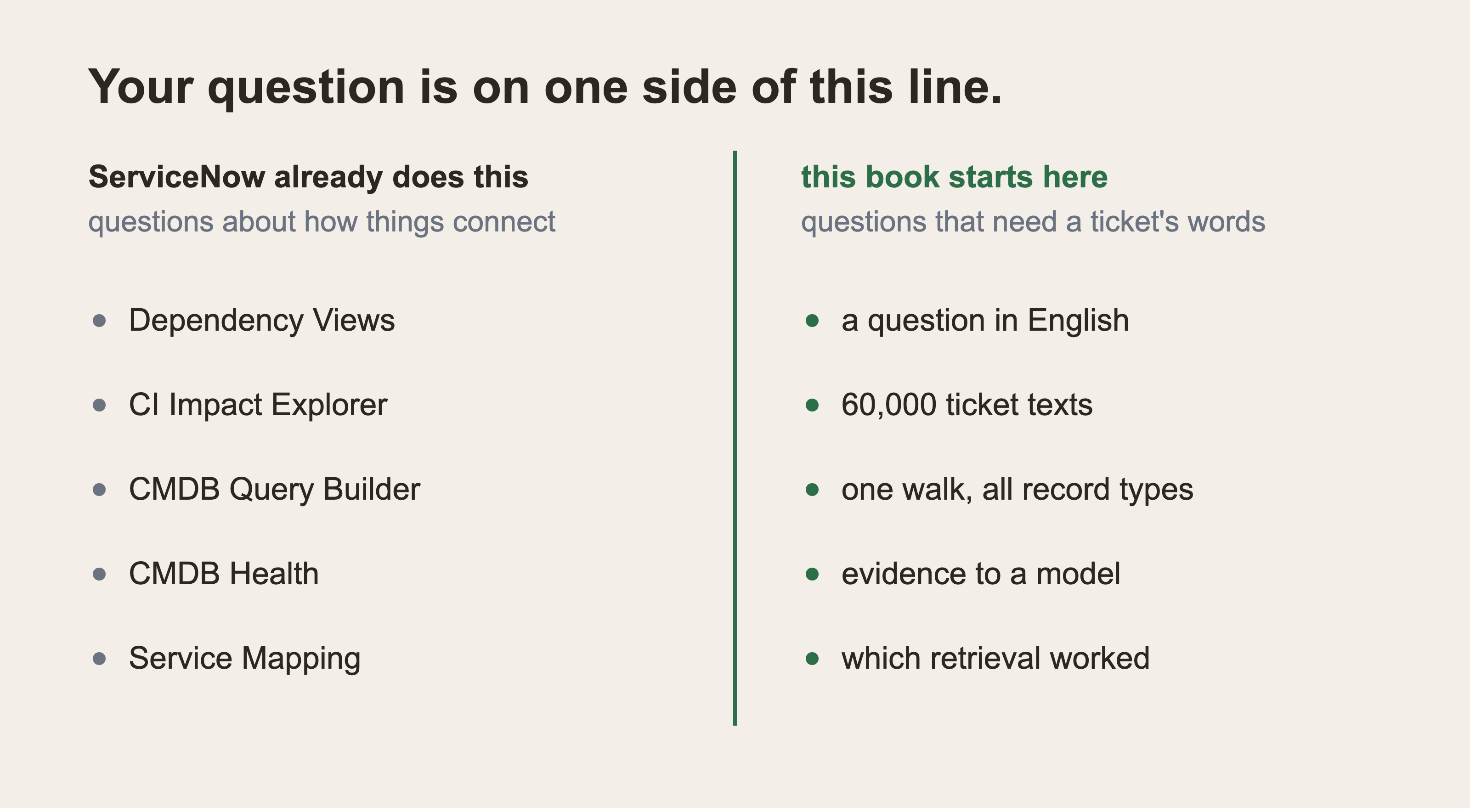
Structural questions go left. Anything that needs the ticket text goes right. By ticket text I mean the words a person typed into an incident rather than picked from a dropdown: its short description, its description, and its work notes. Those fields are free text. Nothing in them is categorised, so no filter and no report can reach what they say.
On the left, Dependency Views opens from one configuration item's own record and draws the map of what that item connects to. The depth is how many relationship hops out it follows: depth 1 is the item's immediate neighbours, depth 3 is everything within three hops of it.
CI Impact Explorer and the Impact Analysis API compute what breaks when something breaks. CMDB Query Builder writes multi-hop queries with no code. CMDB Health measures staleness, completeness and correctness with dashboards. Service Mapping keeps application service maps current on its own.
All five are real, supported, and better maintained than anything in this repository.
The right side is the list of things none of those five tools does, and it is what this book builds. A question typed in English rather than into a form or a filter. The free text of sixty thousand tickets, where a symptom nobody categorised sits in the words an engineer used. One walk that crosses incidents, changes, problems, and knowledge together with the infrastructure. Evidence handed to a model so the answer arrives as a sentence. And a measurement of which retrieval strategy actually returned the right records.
ServiceNow doesn't make you click through records one at a time. It ships tools for exactly the walk I just described:
Dependency Views draws the map from a configuration item's form, to a depth you choose, filtered by relationship type.
CI Impact Explorer and the Impact Analysis API compute what breaks when something breaks.
CMDB Query Builder writes multi-hop graph queries with no code at all.
CMDB Health already measures staleness, completeness and correctness, with dashboards.
With ITOM licensed, Service Mapping keeps application service maps current on its own.
If your question is "what depends on this item", use those. They're built in, they're supported, and they are better maintained than anything you'll write.
Two more ServiceNow products belong on that list, and these two compete with this book directly:
ServiceNow AI Search is the platform's own search engine. It reads a question phrased the way a person would phrase it. It ranks results across the tables it indexes, and can hand back an answer card rather than a list of links. It comes with the platform rather than as a separate purchase. It does have to be configured and indexed first.
Now Assist is ServiceNow's generative AI layer. It summarises a long incident and drafts a resolution note. It answers a question in English from knowledge articles and the records nearby.
So "you can't ask ServiceNow a question in English" is not a sentence I'm willing to write. Now Assist does exactly that, and the people who built the tables built it.
There's also a privacy point I should concede here rather than bury. The ticket text already lives in ServiceNow. A ServiceNow product reading it changes nothing about who holds it, which is not true of a hosted API from somebody else.
What survives is narrower, and it's about price and about proof.
Now Assist is a paid add-on, licensed on top of your platform subscription. It isn't on the free developer instance this book uses. Everything here before Part 8 costs nothing. If your employer already pays for Now Assist, use it. That is a straight recommendation and not a hedge.
So here's the straightforward case for this book. The fi...


