In Python, understanding inheritance and composition is crucial for effective object-oriented programming. Inheritance allows you to model an is a relationship, where a derived class extends the functionality of a base class. Composition, on the other hand, models a has a relationship, where a class contains objects of other classes to build complex structures. Both techniques promote code reuse, but they approach it differently.
By the end of this tutorial, you’ll understand that:
- Composition and inheritance in Python model relationships between classes, enabling code reuse in different ways.
- Composition is achieved by creating classes that contain objects of other classes, allowing for flexible designs.
- Inheritance models an is a relationship, allowing derived classes to extend base class functionality.
- Inheritance in Python is achieved by defining classes that derive from base classes, inheriting their interface and implementation.
Exploring the differences between inheritance and composition helps you choose the right approach for designing robust, maintainable Python applications. Understanding how and when to apply each concept is key to leveraging the full power of Python’s object-oriented programming capabilities.
Get Your Code: Click here to get the free sample code that shows you how to use inheritance and composition in Python.
Take the Quiz: Test your knowledge with our interactive “Inheritance and Composition: A Python OOP Guide” quiz. You’ll receive a score upon completion to help you track your learning progress:
Interactive Quiz
Inheritance and Composition: A Python OOP GuideIn this quiz, you'll test your understanding of inheritance and composition in Python. These are two major concepts in object-oriented programming that help model the relationship between two classes. By working through this quiz, you'll revisit how to use inheritance and composition in Python, model class hierarchies, and use multiple inheritance.
Object-Oriented Python Live Course: Want to practice choosing between inheritance and composition in a real design? In Real Python’s Object-Oriented Python live course, you build a complete simulator with an instructor and decide where each relationship belongs as the project grows. Join the waitlist to hear about the next dates.
What Are Inheritance and Composition?
Inheritance and composition are two major concepts in object-oriented programming that model the relationship between two classes. They drive the design of an application and determine how the application should evolve as new features are added or requirements change.
Both of them enable code reuse, but they do it in different ways.
What’s Inheritance?
Inheritance models what’s called an is a relationship. This means that when you have a Derived class that inherits from a Base class, you’ve created a relationship where Derived is a specialized version of Base.
Inheritance is represented using the Unified Modeling Language, or UML, in the following way:
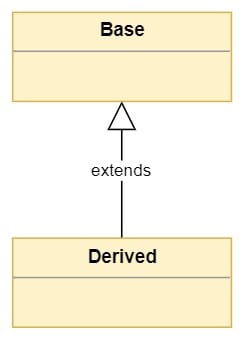
This model represents classes as boxes with the class name on top. It represents the inheritance relationship with an arrow from the derived class pointing to the base class. The word extends is usually added to the arrow.
Note: In an inheritance relationship:
- Classes that inherit from another are called derived classes, subclasses, or subtypes.
- Classes from which other classes are derived are called base classes or super classes.
- A derived class is said to derive, inherit, or extend a base class.
Say you have the base class Animal, and you derive from it to create a Horse class. The inheritance relationship states that Horse is an Animal. This means that Horse inherits the interface and implementation of Animal, and you can use Horse objects to replace Animal objects in the application.
This is known as the Liskov substitution principle. The principle states that if S is a subtype of T, then replacing objects of type T with objects of type S doesn’t change the program’s behavior.
You’ll see in this tutorial why you should always follow the Liskov substitution principle when creating your class hierarchies, and you’ll learn about the problems that you’ll run into if you don’t.
What’s Composition?
Composition is a concept that models a has a relationship. It enables creating complex types by combining objects of other types. This means that a class Composite can contain an object of another class Component. This relationship means that a Composite has a Component.
UML represents composition as follows:
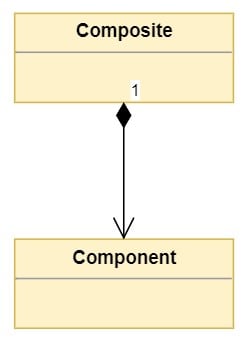
The model represents composition through a line that starts with a diamond at the composite class and points to the component class. The composite side can express the cardinality of the relationship. The cardinality indicates the number or the valid range of Component instances that the Composite class will contain.
In the diagram above, the 1 represents that the Composite class contains one object of type Component. You can express cardinality in the following ways:
Read the full article at https://realpython.com/inheritance-composition-python/ »
[ Improve Your Python With 🐍 Python Tricks 💌 – Get a short & sweet Python Trick delivered to your inbox every couple of days. >> Click here to learn more and see examples ]


