AI & ML
Sequential Monte Carlo approximations of Wasserstein--Fisher--Rao gradient flows
arXiv cs.NA0 views
arXiv:2506.05905v3 Announce Type: replace-cross Abstract: We consider the problem of sampling from a probability distribution $\pi$. It is well known that this can be written as an optimisation problem over the space of probability distribution in which we aim to minimise the Kullback--Leibler divergence from $\pi$. We consider several partial differential equations (PDEs) whose solution is a minimiser of the Kullback--Leibler divergence from $\pi$ and connect them to well-known Monte Carlo algorithms. We focus in particular on PDEs obtained by considering the Wasserstein--Fisher--Rao geometry over the space of probabilities and show that these lead to a natural implementation using importance sampling and sequential Monte Carlo. We propose a novel algorithm to approximate the Wasserstein--Fisher--Rao flow of the Kullback--Leibler divergence and conduct an extensive empirical study to identify when this algorithm outperforms other popular Monte Carlo algorithms.
Source:https://arxiv.org/abs/2506.05905PreviousA staggered discontinuous Galerkin neural network method with a computable error decompositionNextOn Approximate Computation of Critical Points
Related posts

Here’s Everything You Can Do With With the New Gemini AI on Android Auto
0Wired
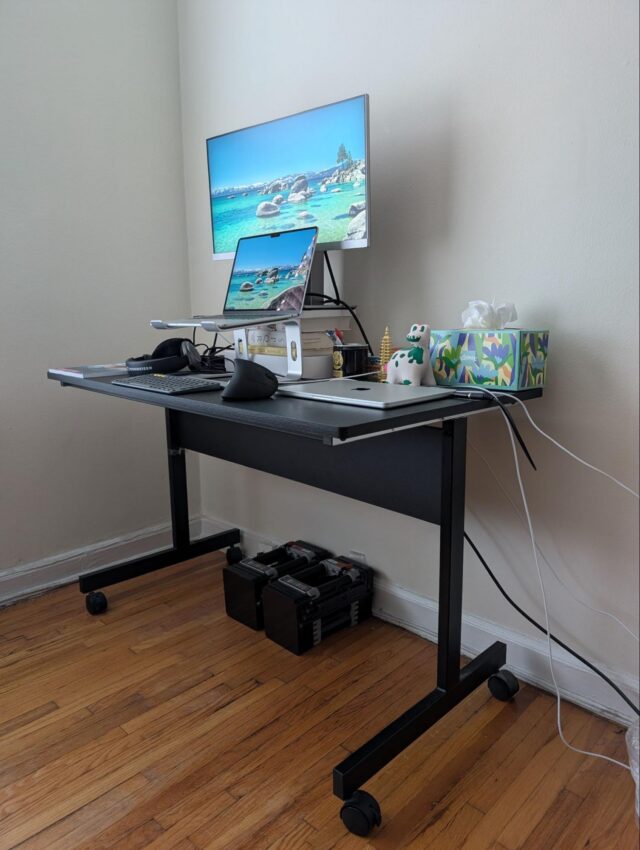
From minimalist to maximalist: Ars staffers show off their home offices
0Ars Technica

Draining peatlands is responsible for a few percent of our global warming
0Ars Technica

Waymo conquered city streets — why does it keep stumbling on freeways?
0The Verge

The Email That Should Have Been a Five-Minute Call
0dev.to

Which sites block GPTBot, ClaudeBot and PerplexityBot? The robots.txt files of 1,000 top domains
0dev.to