Python supply chain security means protecting everything your project pulls in and runs, from PyPI packages to CI workflows and publishing credentials, so that a tampered release or stolen token can’t turn your own tools against you.
AI-assisted analysis makes it cheaper to turn a bug fix into a working exploit, so attacks now arrive within hours of a fix, and sometimes before it. For Python projects, that speed hits two weak spots. One is code that runs when you install a package or start Python. The other is keys that sit where that code can read them.
By the end of this tutorial, you’ll understand that:
- A supply chain attack reaches you through components you already trust, such as a dependency, its build pipeline, or the token that publishes it.
.pthfiles andsitecustomize.pyrun code during Python’s normal startup, even if you never import the package that installed them.- A dependency cooldown guards against malicious new releases, while audits flag known vulnerable versions that you then fix.
- Short-lived, narrowly scoped tokens limit how far one bad package can reach.
- AI coding agents can install hallucinated or booby-trapped packages, so make them ask first.
You’ll look at two incidents from October 2026, check your own environments without setting off a hidden hook, and pick up three habits that hold up at that speed. The commands assume a Linux or macOS shell and uv.
Further Reading: For secure-coding basics, keep the Python Security Checklist handy. If an agent writes your code, then check out How to Review AI-Generated Python Code Efficiently.
Free Bonus: Download the Python Supply Chain Security Cheat Sheet PDF and keep the essentials at hand.
What Is Python Supply Chain Security?
Every time you install a package, you trust code that strangers wrote, that their pipelines built, and that their tokens uploaded to PyPI. Supply chain security covers that whole path until the code runs in your virtual environment.
A restaurant works the same way. It doesn’t grow its own vegetables, so it depends on suppliers. If one supplier delivers a bad batch, then the problem reaches every plate that uses it, no matter how clean the kitchen is.
In Python terms, the packages you list in pyproject.toml are your direct dependencies. The packages they pull in are transitive dependencies. Install requests, and you also get certifi, charset-normalizer, idna, and urllib3. Each one is another supplier you trust.
What’s new is the speed. Amazon’s threat intelligence team writes that AI-assisted analysis “makes it cheaper to turn a patch diff or advisory into a working exploit.” When a fix ships, attackers can study what changed and go after everyone who hasn’t updated yet.
Two Python risks stand out, and you’ll meet both again below:
- Code that runs at install and startup: A package’s build step can run code while you install it. After that,
.pthfiles andsitecustomize.py, which normally add import paths or set up an environment, run during thesitemodule’s setup at each normal Python start, so a tampered release doesn’t need you to import anything. - Keys that sit around: API keys, cloud credentials, and publishing tokens often live in environment variables, config files, and logs, where any code running as your user can read them.
Attacks Now Move at AI Speed
Have a look at two incidents from October 21, 2026. PHP2Shell provides the timing evidence, and LiteLLM shows the Python mechanism. The details are as of October 22, 2026, and may still change.
PHP2Shell: Probed Before the Fix, Exploited Within Hours of It
PHP2Shell is the name researchers gave to two PHP bugs that let an attacker run code on a web server without logging in. PHP rated both at 9.2 on the CVSS severity scale. Two teams found them independently with AI help. Calif worked as part of OpenAI’s Patch the Planet initiative and credits OpenAI’s GPT-5.6 Sol model, and Wiz used Gemini 4 Argon and GPT-5.6 Sol. Here’s PHP’s advisory from October 21:
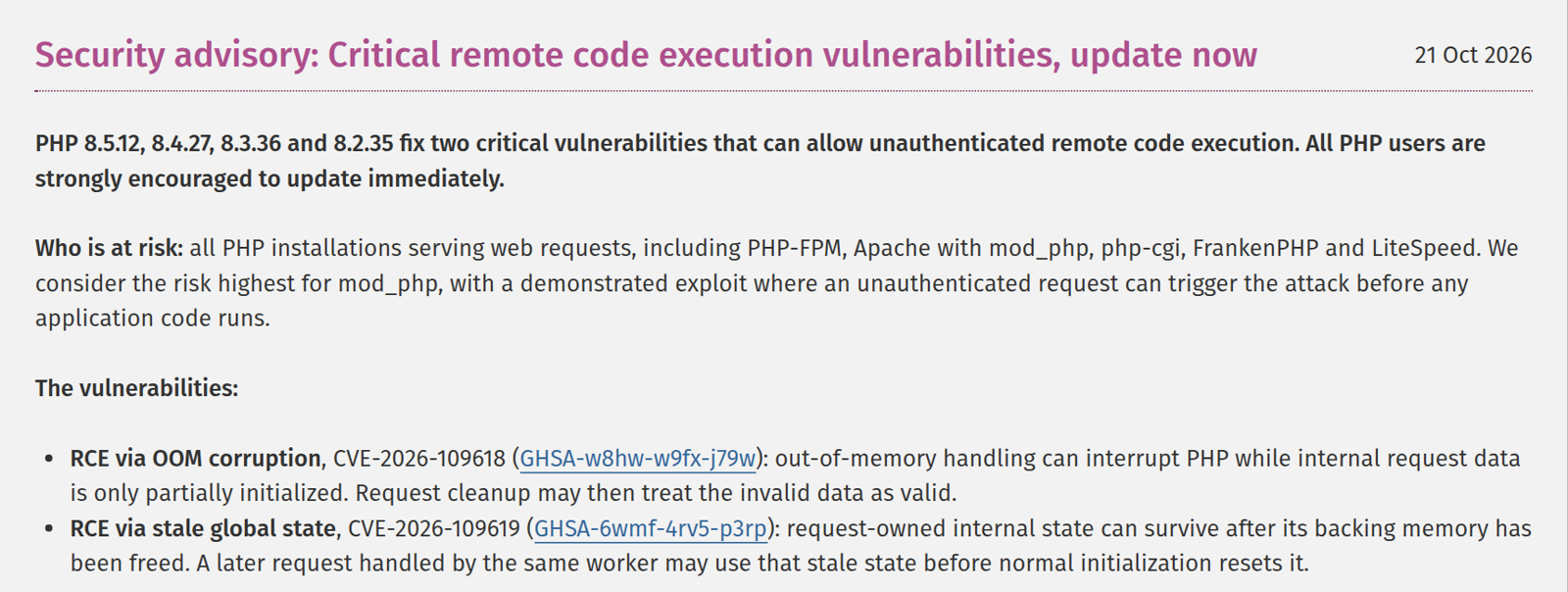
Amazon’s honeypots, decoy servers that record attacks, caught attempts days before that release. For comparison, the chart below adds Rapid7’s Q3 2026 average of three days from disclosure to exploitation, among the 43 newly exploited high- and critical-severity vulnerabilities it tracked. Attackers often move before the fix is public or within hours of it. That leaves a seven-day patch policy far behind:
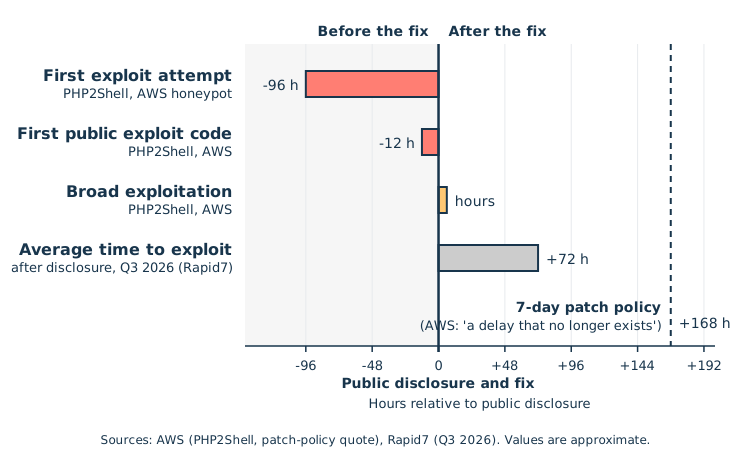
PHP isn’t Python, but the lesson carries over. When a fix and the first attacks land on the same day, the defenses that count are the ones already in place.
Read the full article at https://realpython.com/python-supply-chain-security/ »
[ Improve Your Python With 🐍 Python Tricks 💌 – Get a short & sweet Python Trick delivered to your inbox every couple of days. >> Click here to learn more and see examples ]


