AMD late on Tuesday reported its highest quarterly revenue ever as demand for its Epyc data center processors and Instinct AI accelerators nearly doubled year-over year and sales of its products for client systems were down only modestly despite high memory prices and other headwinds.
As increasing sales of data center hardware more than offset declines in the client realms, AMD's profitability continues to improve. Perhaps the most striking announcement AMD made is that it expects its Q4 revenue to reach approximately $17 billion, which would put it ahead of Intel for the first time in history.
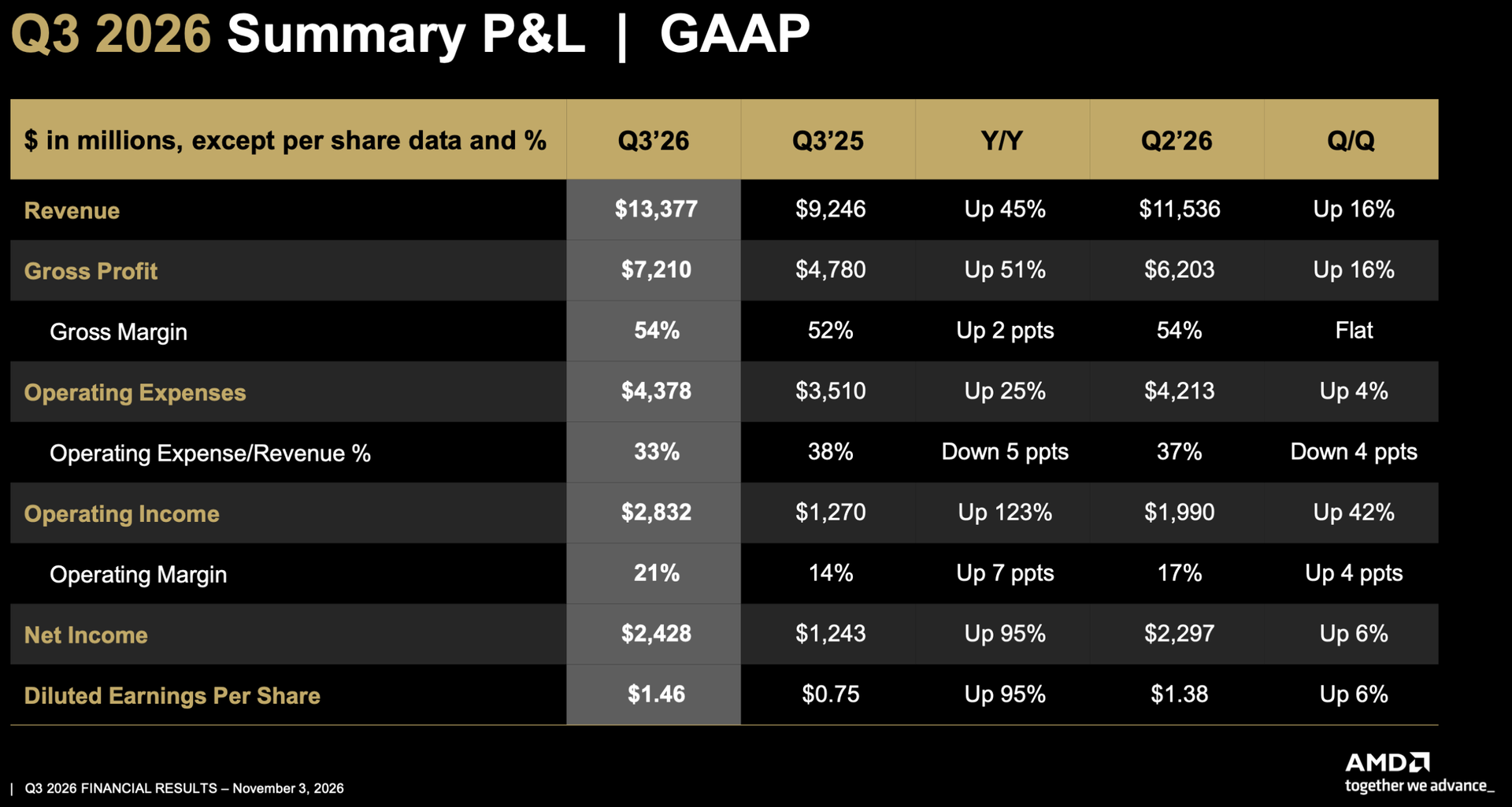
AMD's third-quarter revenue reached $13.377 billion, a huge increase from $9.25 billion in the same quarter a year earlier and $11.54 billion in the previous quarter. The company's gross margin was 54% during the quarter, and net income increased by 95% to $2.43 billion. Diluted earnings per share reached $1.46, compared with $0.75 in the same quarter last year.
Data center business now accounts for 64% of AMD's revenue
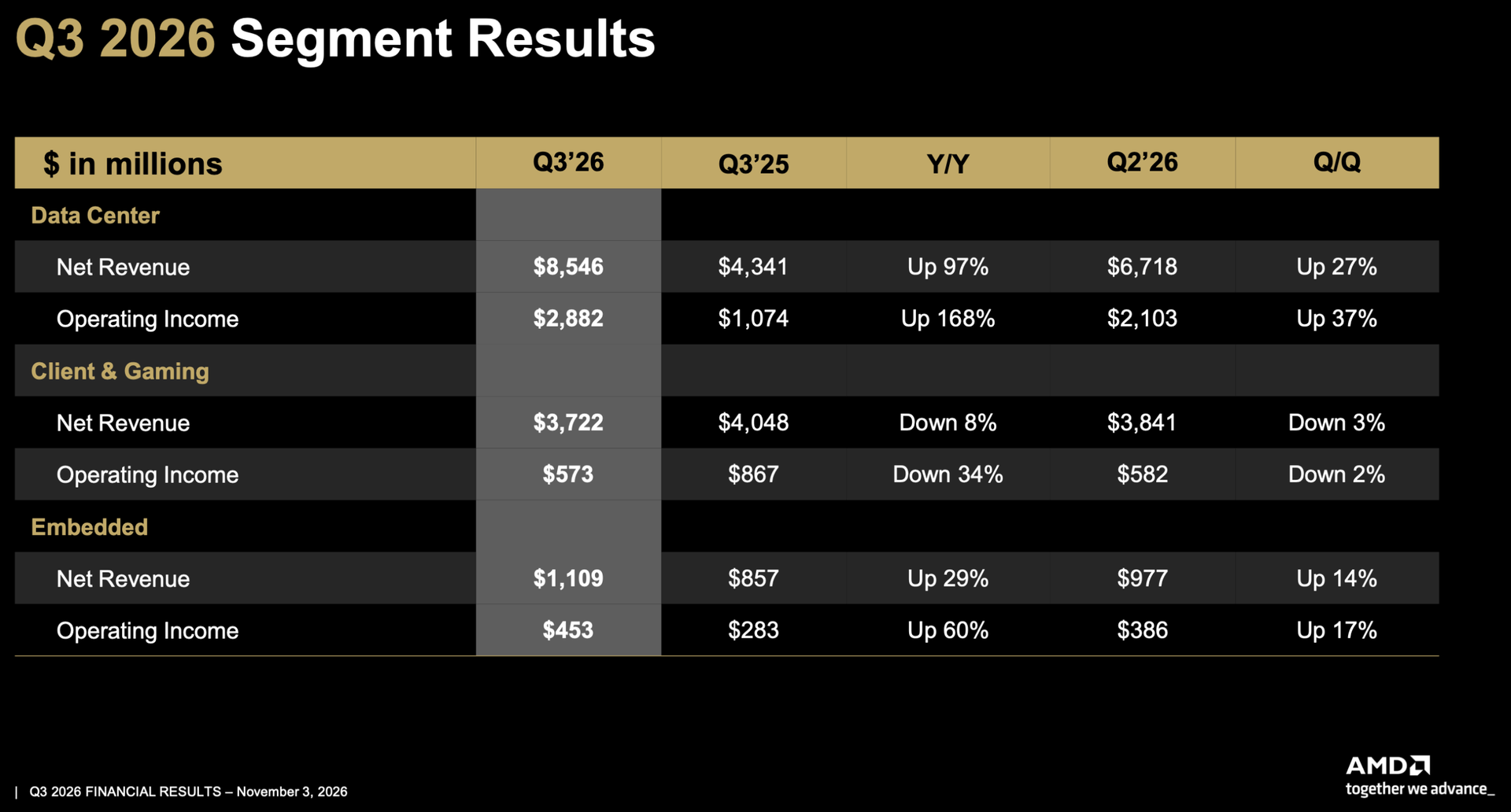
AMD's Data Center business was the main driver of its growth as the unit's sales reached a record $8.55 billion, up 97% from $4.34 billion a year earlier and 27% sequentially. The unit's operating income surged by 168% to $2.88 billion, while operating margin expanded from 25% to 34%.
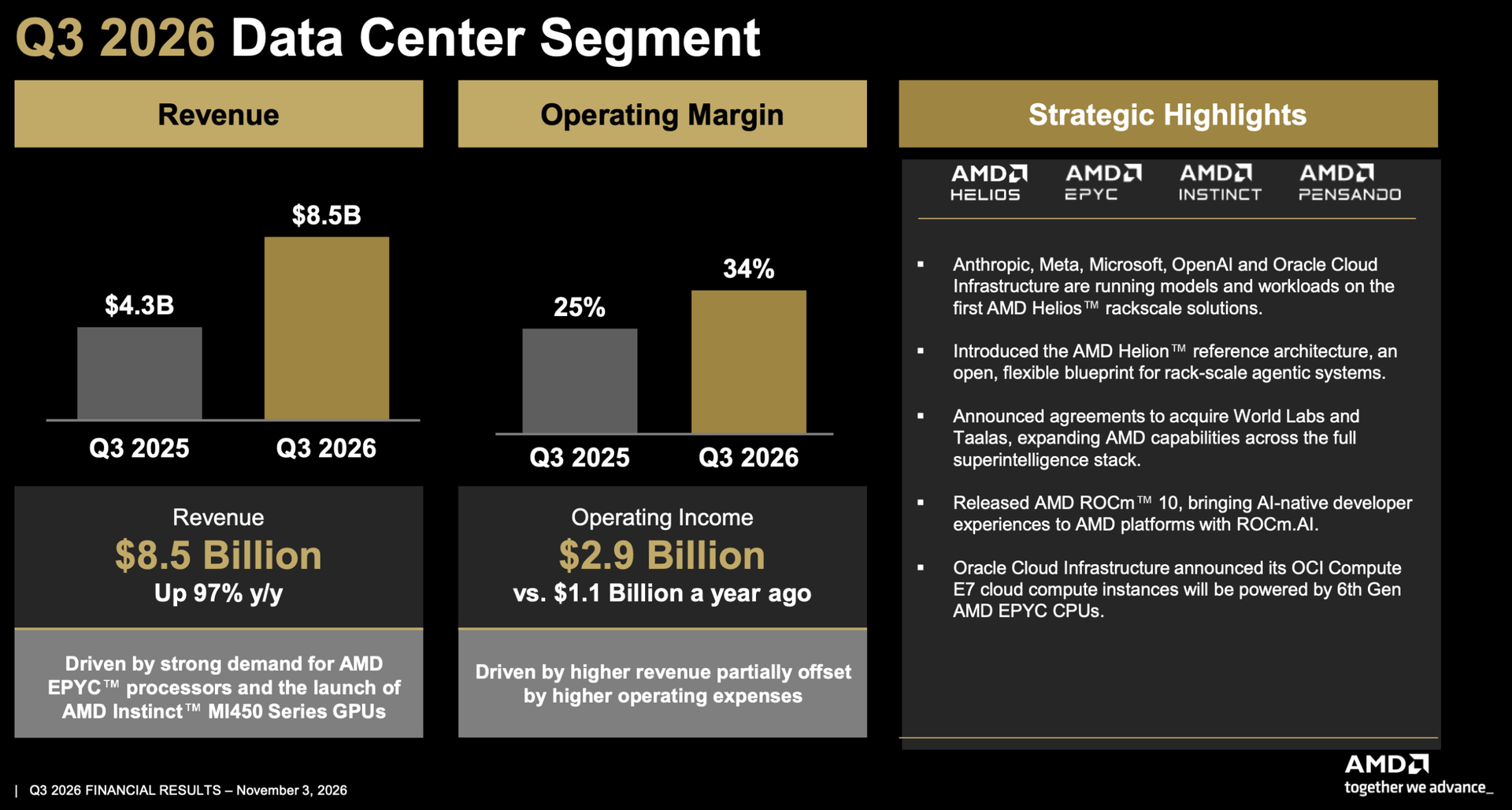
The company attributed the results to strong demand for its latest Epyc processors and the launch of Instinct MI455X AI accelerators, which power its Helios rack-scale systems. Specifically, AMD noted that Anthropic, Meta, Microsoft, OpenAI, and Oracle Cloud Infrastructure are already running workloads on their first Helios systems.
AMD expects its Data Center revenue to increase from $8.55 billion in Q3 2026 to approximately $12.8 billion in Q4 (based on the company's guidance), driven by the ramp of Instinct MI455X accelerators and Helios systems. The company also projects that its server CPU revenue will double in 2027, while Data Center AI accelerator and rack revenue will more than double, which will push the DC unit's contribution to over 80% of total company sales, up from 64% this past quarter and from 47% in Q3 2025.
"We now expect server revenue to double year over year in 2027 and data center AI revenue to grow even faster than we projected ninety days ago," said Lisa Su, chief executive and chairman of AMD, during the company's earnings call with analysts and investors. "As a result, we expect data center to be more than eighty percent of our total revenue in 2027 and to drive the majority of our revenue and earnings growth."
Client revenue up, gaming revenue drops
AMD's Client and Gaming business unit generated $3.722 billion in revenue, down 8% year-over-year and 3% quarter-over-quarter.
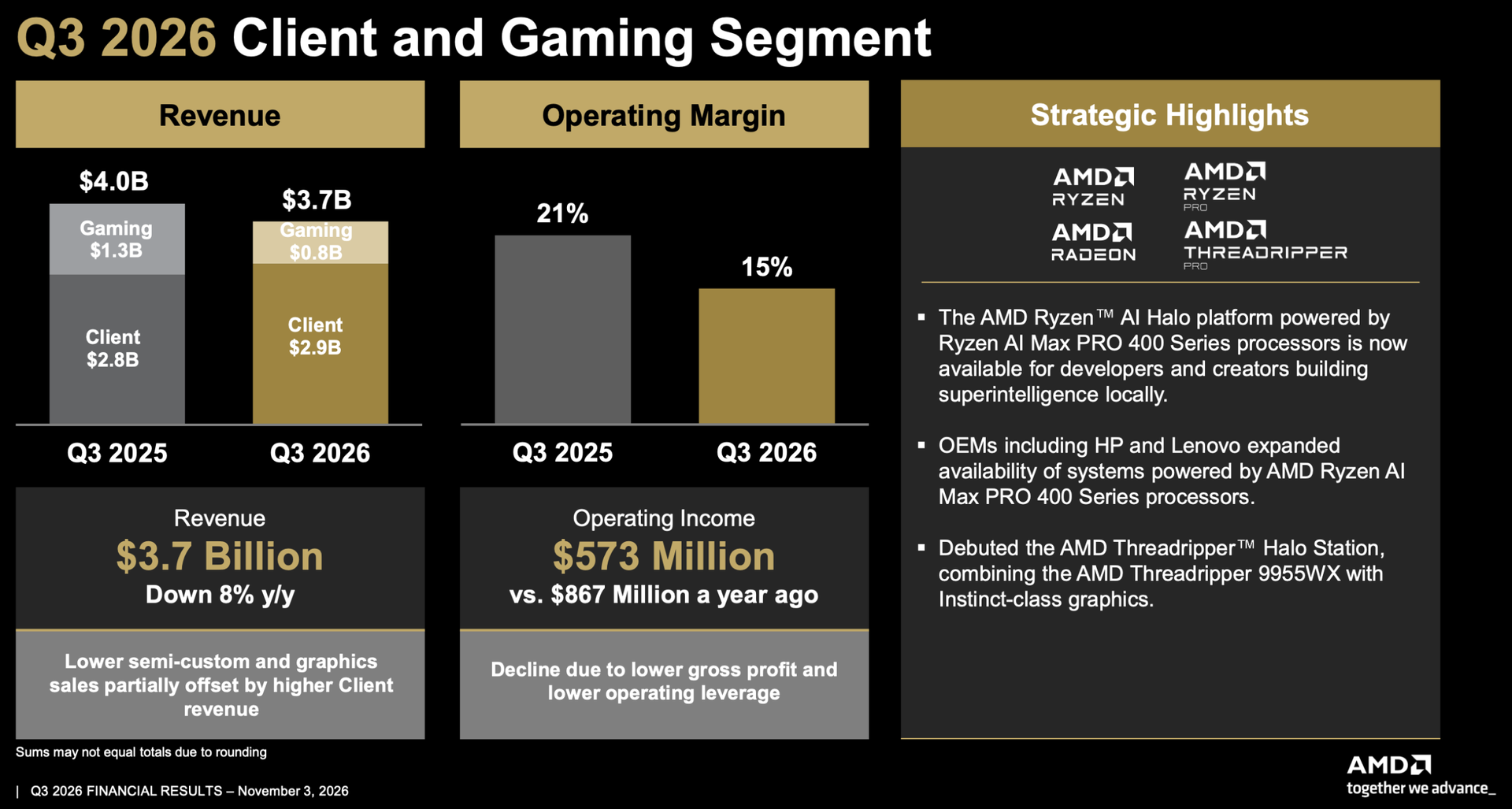
Meanwhile, sales of AMD's client CPUs totaled $2.95 billion, down from $3.06 billion in the previous quarter and up around $200 million from $2.75 billion in the same quarter a year ago.
Sales of AMD's gaming products — including discrete GPUs and system-on-chips for game consoles — dropped to $773 million from $1.298 billion in the previous year as Microsoft and Sony bought fewer console SoCs, while sales of discrete Radeon RX GPUs remained weak during the quarter. The combined segment's operating income dropped by 34% to $573 million as the unit's operating margin decreased to 15%.
"In 2027, we are planning for PC market unit shipments to decline by a double-digit percentage," Su said. "In this environment, we expect to outperform the market as we deliver our rising roadmap and grow our commercial footprint."
AMD projects its Client and Gaming business to contract by more than 20% sequentially in Q4 2026 as higher memory prices weaken PC demand. The company is also preparing for a double-digit decline in PC shipments in 2027, although it expects to outperform the market by concentrating on enterprise, premium consumer, and desktop processors. Unfortunately, AMD did not provide a specific revenue forecast for its Client and Gaming segment for 2027.
Embedded business strong, set to accelerate
As for AMD's Embedded business, it also demonstrated strong growth as its revenue increased by 29% year-over-year to $1.11 billion and operating income rose by 60% to $453 million. The company attributed the improvement to stronger demand from aerospace and defense, automotive, communications, and industrial customers.
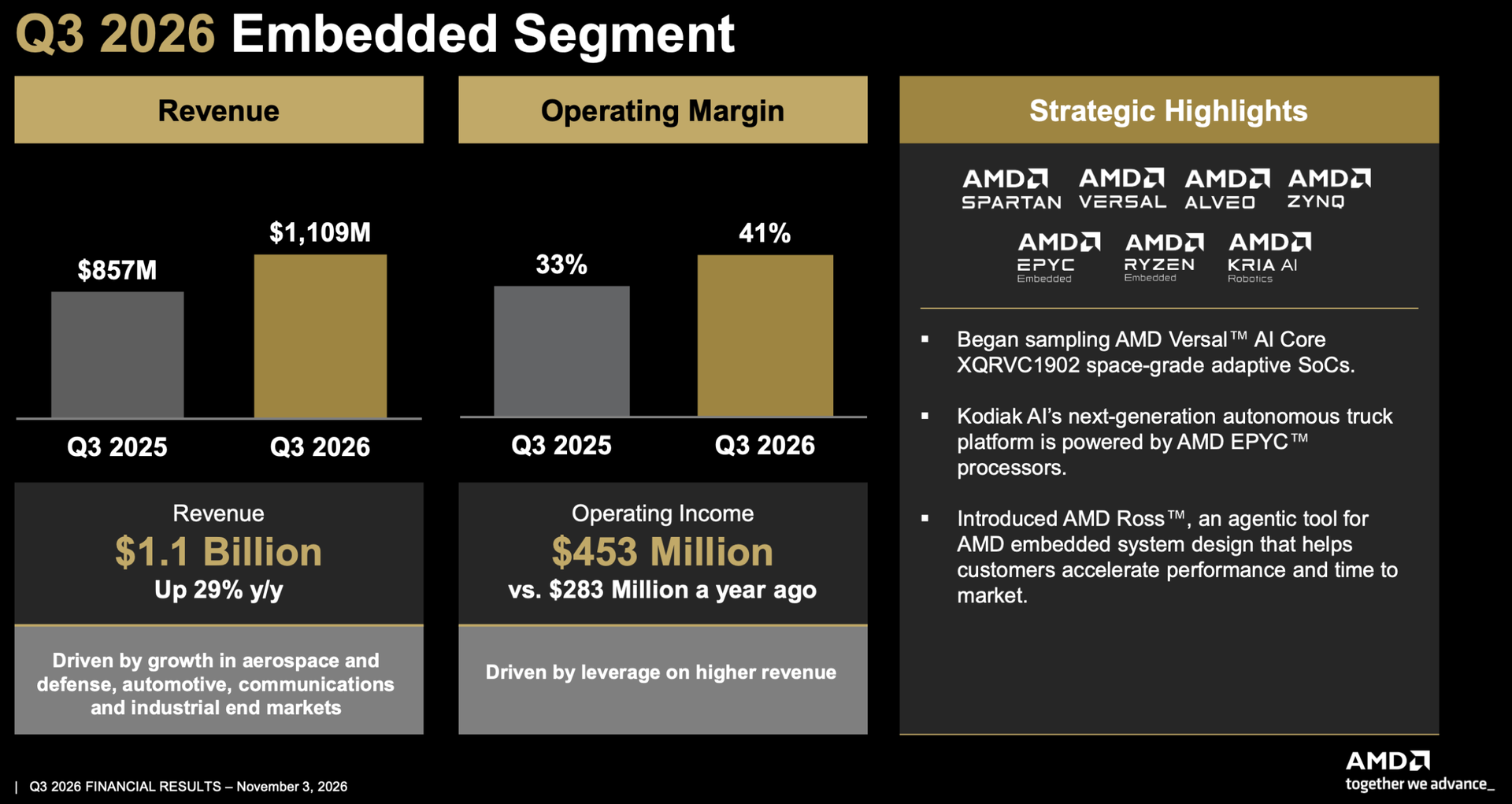
AMD expects its Embedded business to grow by double digits sequentially in Q4 2026, then experience double-digit annual revenue growth over the next several years.
"Data center build-outs are also driving higher demand for our embedded CPUs and adaptive SoCs in control plane and optical networking applications," said the head of AMD. "We remain on track to close more than eighteen billion of design wins in 2026, our third consecutive record year."
Beating Intel
For those of our readers who have been following the CPU market in general as well as AMD and Intel in particular for decades, arguably the most earth-shattering part of AMD's earnings report is its outlook for the fourth quarter. The company expects revenue of approximately $17 billion, plus or minus 3%, which implies a 66% year-over-year increase and 27% sequential growth at the midpoint.
In contrast, Intel expects fourth-quarter revenue of $15 billion to $16 billion amid weakening PC demand and manufacturing capacity constraints.
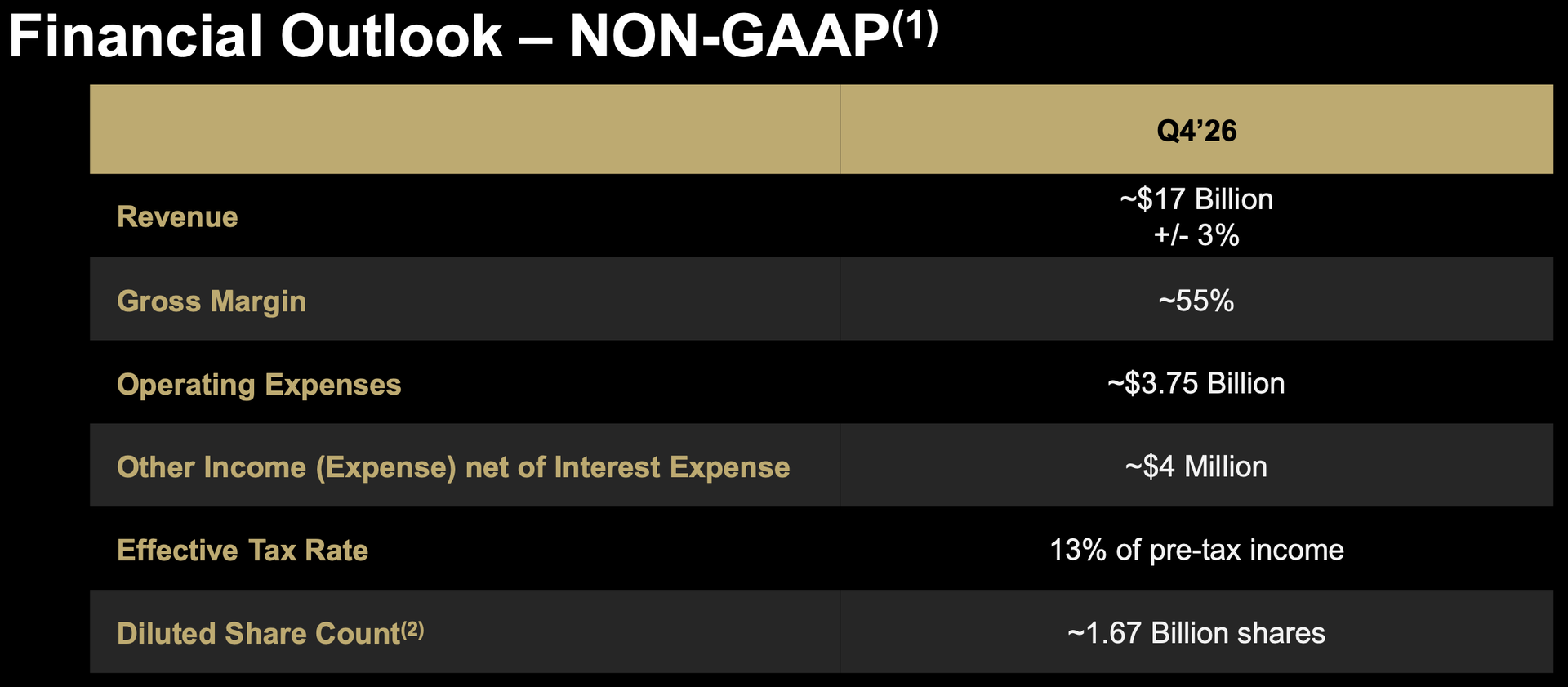
If AMD meets its guidance, its quarterly sales will surpass those of its considerably bigger rival Intel for the first time in history. In fact, AMD will not only leave Intel formally behond, but its projected advantage will be approximately $1.5 billion at the midpoint of both companies' forecasts, which is a tangible lead.
The development reflects the companies' increasingly different positions on the market: AMD is rapidly expanding its data center CPU and AI accelerator businesses, while Intel continues to depend heavily on PC and enterprise server processors, which sales face headwinds due to high memory prices and components shortages.


