General
Balanced Boolean Functions from Sparse Niho-Type Permutation Polynomials: Few-Valued Walsh Spectra and Applications
arXiv math.IT0 views
arXiv:2611.27371v1 Announce Type: new Abstract: We study balanced Boolean functions parameterized by two-to-one mappings of the forms $P(x+x^2)$ and $P(x+x^{-1})$, where $P$ is a sparse permutation polynomial with generalized Niho-type exponents. First, for $q=2^m$ with $m$ even, we determine the complete four-valued Walsh distribution of the balanced Boolean function parameterized by $Q(x+x^2)$, where $Q(x)=x(1+x^{q-1}+x^{2(q-1)})$. We then generalize a permutation polynomial studied by Gupta and Sharma to the parameterized family $P_\lambda(x)=x^{3q-1}+\lambda x^{2q}+\lambda x^2$ over $\mathbb{F}_{q^2}$. We prove that $P_\lambda$ is a permutation polynomial if and only if either $\lambda=0$, or $\lambda\ne0$ and $X^3+X+\lambda^{-1}$ has no root in $\mathbb{F}_q$. Moreover, the number of admissible parameters is $(q+2)/3$ when $m$ is even and $(q+4)/3$ when $m$ is odd. Thus, admissible parameters exist for every $m\geq2$, and approximately one-third of the elements of $\mathbb{F}_q$ yield permutation polynomials. For every admissible parameter $\lambda$, we determine the complete Walsh distribution of the balanced Boolean function $f_\lambda$ parameterized by $P_\lambda(x+x^2)$ and prove that this distribution is independent of $\lambda$. For $m\geq3$, these functions have the five-valued Walsh spectrum ${q,0,-q,-2q,-3q}$, while for $m=2$ the spectrum degenerates to four values. As applications, their supports yield projective minimal binary five-weight codes, sets with five hyperplane intersection numbers, and regular cubelike Cayley graphs with six distinct eigenvalues. Finally, for mappings of the form $P(x+x^{-1})$, we construct an infinite family of balanced Boolean functions with simple explicit trace representations.
Source:https://arxiv.org/abs/2611.27371PreviousA Geometric Approach to the Classification of Locally-APN Niho-Type Power FunctionsNextCoding Length and Optimal Power Allocation in Correlated Block Fading
Related posts
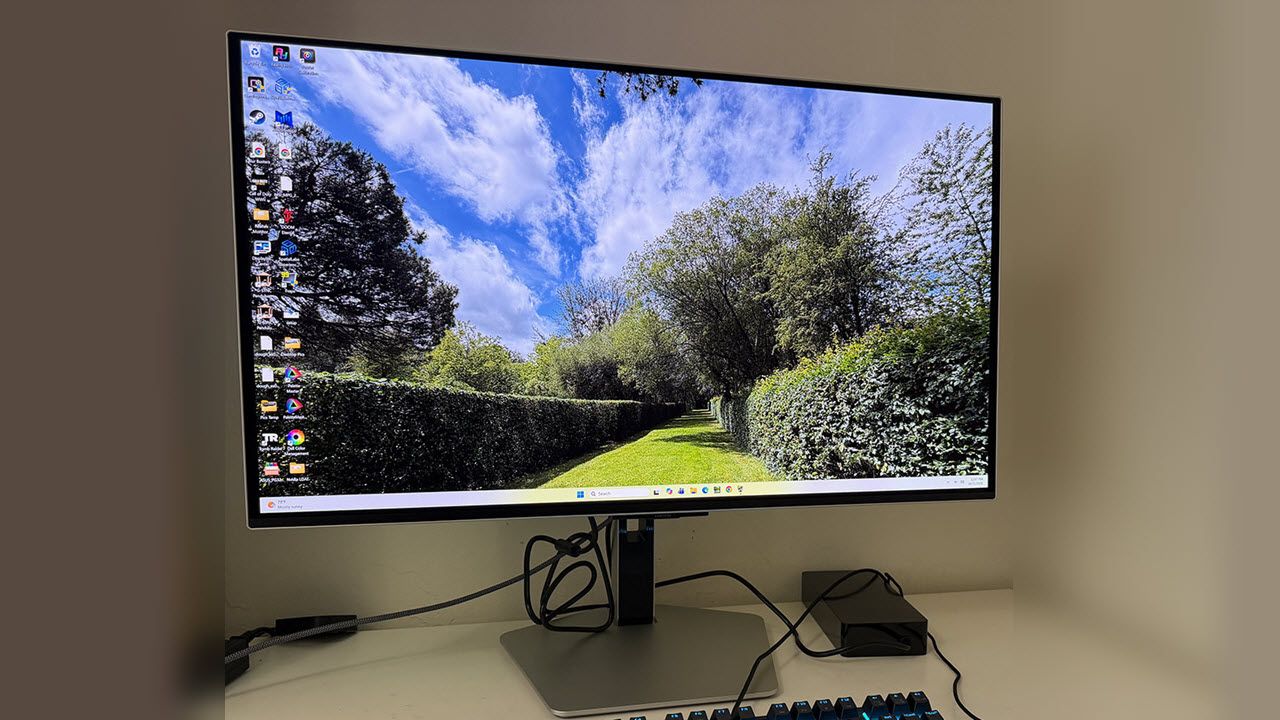
Samsung Odyssey G8 G80SH 32-inch 4K OLED gaming monitor review: Color, performance and style
0Tom's Hardware

How to make climate anxiety your superpower
0Nature News

‘Mozart of maths’ Terence Tao is your guide to what underpins reality
0Nature News

Jensen Huang is back as Nvidia’s CEO
0The Verge

Tesla’s FSD v15 turns driving visuals into Grand Theft Auto
0The Verge

The Verge’s favorite holiday gifts that cost $50 or less
0The Verge