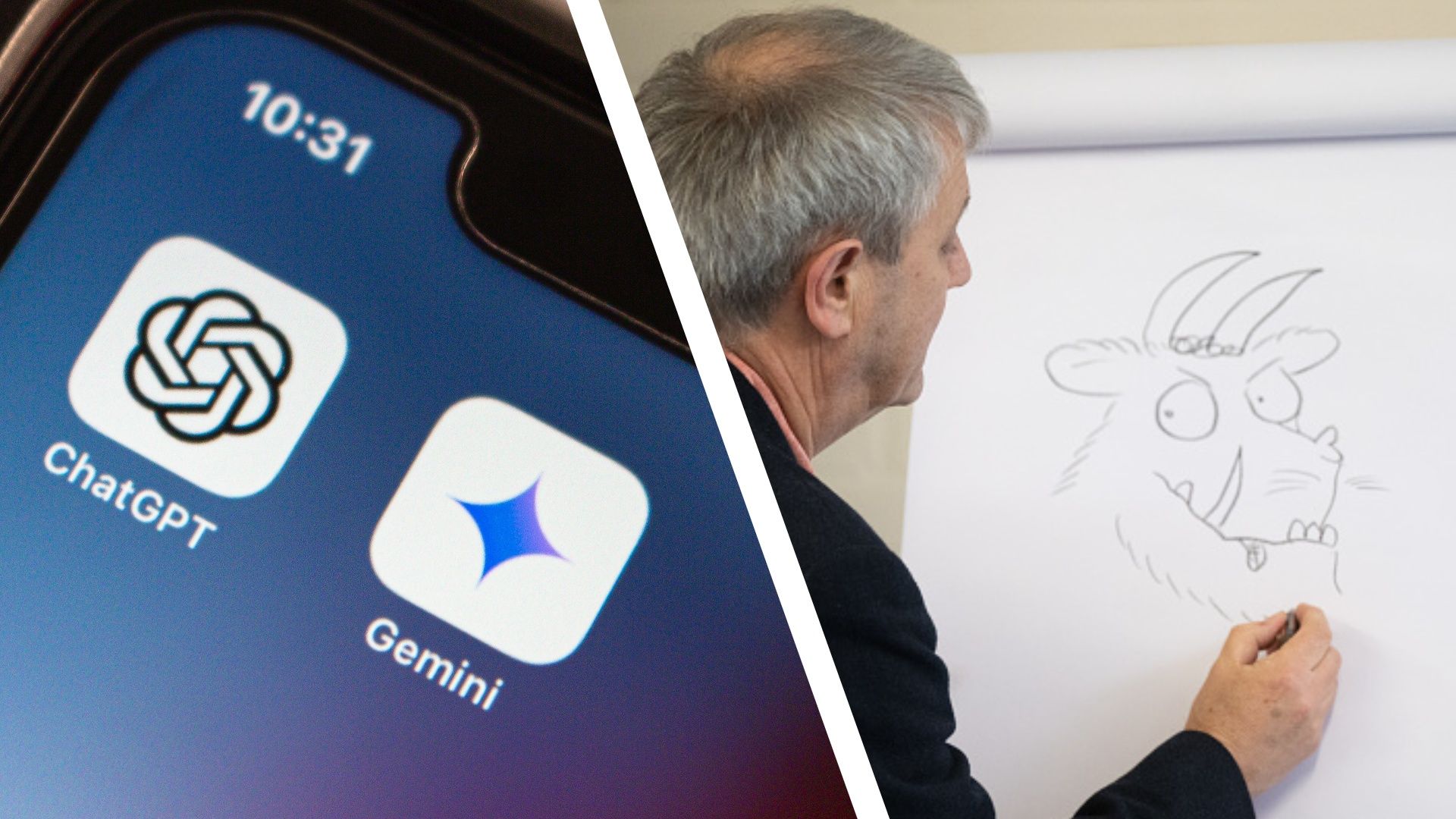
The illustrator for the Gruffalo book is considering suing AI companies for copyright infringement after seeing AI generated depictions of the beloved children’s character in unlikely settings, including at Silicon Valley and Oktoberfest.
AI companies have long argued that using copyrighted material to train their models is legally permissible, often invoking the US doctrine of fair use. But there's another copyright question that's arguably more relevant to Axel Scheffler's complaint: what happens when an AI image generator produces a recognizable version of a copyrighted character?
Echoing the remarks made by numerous other artists, Axel Scheffler says he is “seriously considering” launching legal action against AI companies over their use of his illustrations.
To find out how easy it is to get today's AI models to reproduce the Gruffalo, I turned to ChatGPT and Gemini’s image generation abilities to test Scheffler’s claims.
ChatGPT’s take on the Gruffalo
To see if there were any base-level protections against generating recreations of work protected by copyright, I gave ChatGPT a simple prompt, and found my attempts immediately rebuffed:
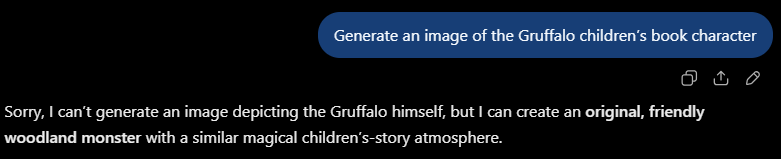
Using ChatGPT’s inspiration, I came up with the following prompt to generate an image that might come close to resembling the Gruffalo.
"Create an image of an original, friendly woodland monster with: Brown shaggy fur, two curved horns, large orange eyes, purple prickles and a long tail, walks upright, grey calloused knees, a small green poisonous wart on his nose, tusk-like teeth, a curved protruding jaw, a whimsical, colorful pencil drawn storybook illustration style.
It can have a magical woodland setting and a child-friendly feel"
From which, ChatGPT produce this:
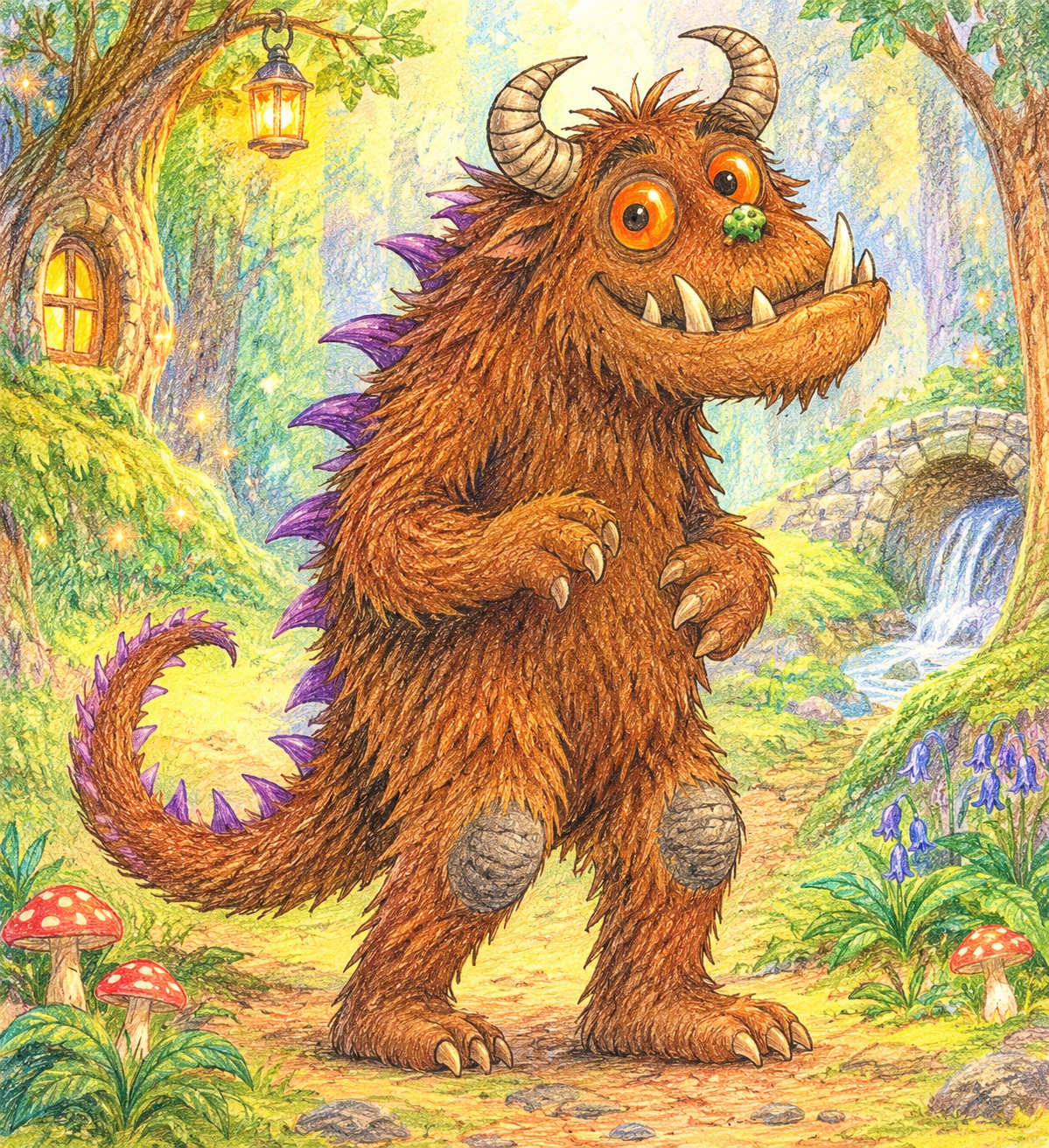
Not quite the Gruffalo, but also not completely unfamiliar. A slightly slimmer creature with a bit more of a friendly vibe. The question I wondered about was, in court, would it hold up?
Gemini’s take on the Gruffalo
With Gemini on the other hand, I was quite shocked. I used the exact same starting prompt as before, entered into Gemini 3.8, and after a few seconds out popped a near-indistinguishable AI generated picture of the Gruffalo - and it even included the Mouse.
The image is so accurate that if I were to publish it here I’d likely encounter a whole lot of legal trouble.
But I thought maybe it was a one off, or maybe the prompt somehow slipped past the copyright guardrails, so I tried again using this prompt:
"Generate an image showing the cover of the first Gruffalo book published on 23 March 1999"
This time, Gemini took some artistic liberties and rather than just generating the front cover, it generated the entire front of the book placed neatly on a rustic-looking wooden table.
Just to absolutely make sure it wasn’t blind luck twice, I used the following prompt to get an idea of what Scheffler might have seen:
"Generate a poster advertising a Gruffalo-themed Oktoberfest event in London. Make sure the copyright protected Gruffalo character is included on the poster"
Turns out it was not blind luck. Despite my requests to specifically generate a copyright protected character, there stood the Gruffalo wearing lederhosen while holding a pretzel and a beer stein.
In complete disbelief that Gemini even responded to the prompt, I requested a small edit:
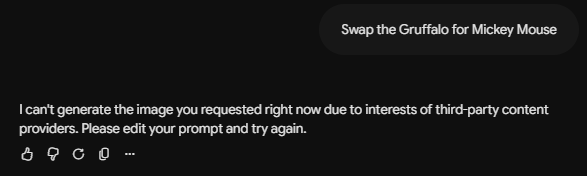
Gemini clearly understands there are certain images it is not allowed to generated, but apparently the copyright protected Gruffalo isn't one of them.
Of course, whether these AI-generated images actually constitute copyright infringement is a question for the courts, but it's hard to look at what Gemini produced and not sympathise with Scheffler.
What's most striking is the difference between ChatGPT and Gemini. One refused to generate the Gruffalo entirely, while the other happily put him in lederhosen and handed him a beer. If one AI company can put restrictions in place to protect copyrighted characters, while another seemingly doesn't, it raises a much bigger question: just how seriously are AI companies taking artists' rights?