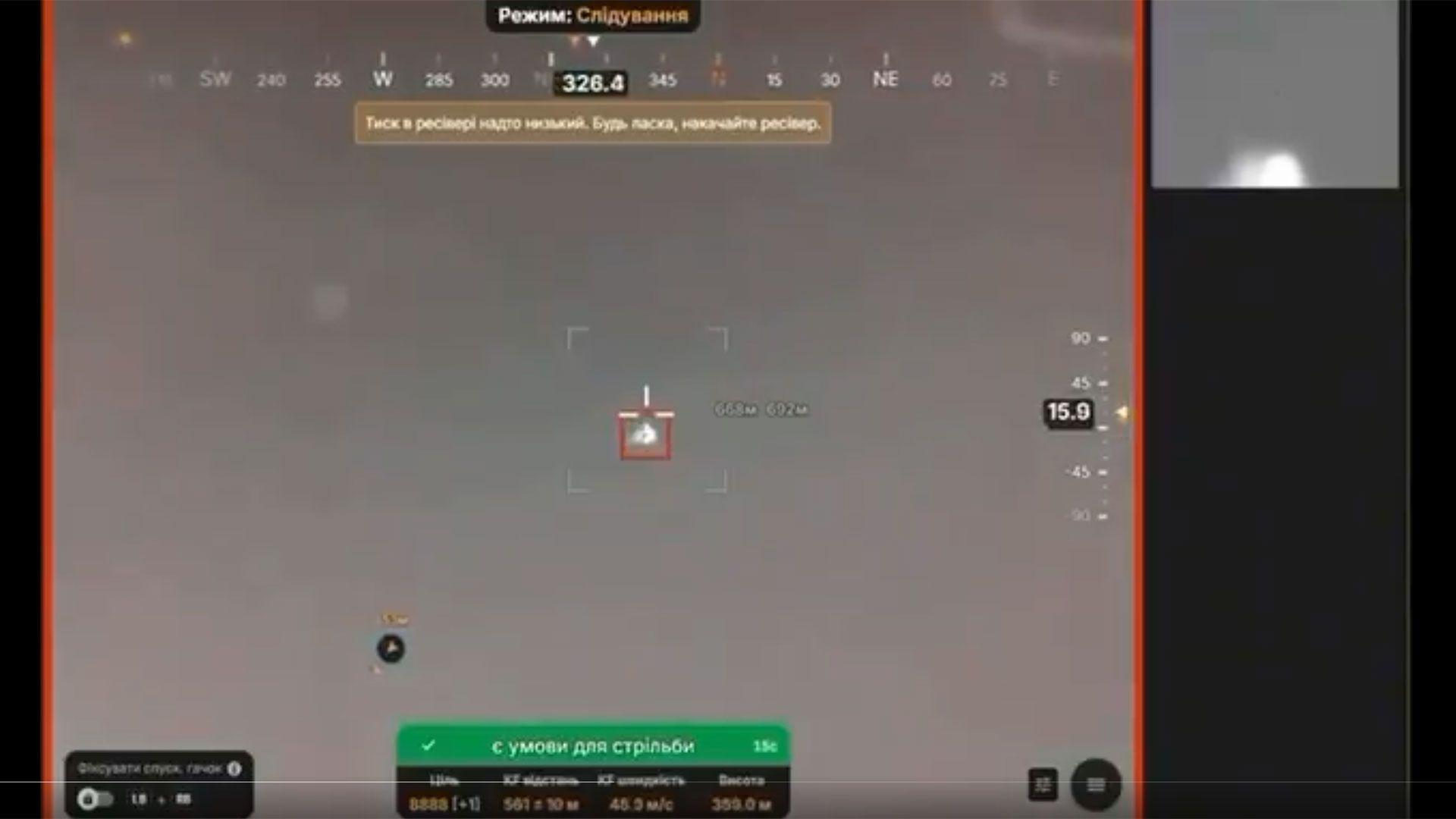
Ukraine has shot down a Russian jet-powered Shahed drone using an air defense laser, reports the Kyiv Independent. This is a first for the 'Blysk' laser system, developed by Ukraine's defense tech company Carmine Sky, and which was deployed on November 19. The news was supported by a Telegram post with embedded video shared by Serhii 'Flash' Beskrestnov, the defense tech advisor to President Zelensky.
For the first time, Ukrainian forces have shot down a Russian jet-powered attack drone using a laser weapons system. https://t.co/PV9xTu3pdkNovember 25, 2026
Flash explains that the Blysk is currently being tested in active duty to protect an unnamed "critical infrastructure facility" [machine translation of Telegram post content]. Though only in testing for a few days, it seems to have already been a success, as it is the first time a laser has been used to destroy one of the speedy new jet-powered drones Russia has begun to deploy in the conflict.
The 'Geran' drones mentioned by the source publication are Russian adaptations of the Iranian Shahed drones. Russia has used multiple iterations of the Iranian design, dubbed the Geran-2, Geran-5, etc.
Despite the celebratory post highlighting the first jet drone laser kill, Flash was realistic about the technology's potentially slow rollout. "It is still too early to discuss serial production of the laser," wrote the tech advisor on Telegram.
It isn't only Carmine Sky that is working on laser defense tech, noted Flash. This highly complex and capital-intensive battlefield tech is being worked upon by "several companies in Ukraine," it was claimed. We've also seen lasers touted as attractive anti-drone solutions by other nations.
Even if they might be expensive to develop, lasers are often praised for their low cost per shot. Blysk reportedly has a power output of 4kW, and using a shot of energy of this magnitude is far cheaper than firing a missile, for example. We've seen it claimed that the UK's DragonFire laser weapon costs roughly £10 ($13) per shot in energy consumption, and the Blysk cost per shot is probably in the same ballpark.
The source report says that weather hasn't been ideal for laser defenses recently, with "persistent cloud cover and fog." Unlike missiles and bullets, common weather phenomena like cloud cover can seriously weaken a laser beam before it reaches its target. Lasers will likely therefore never replace kinetic forms of air defense, but will be deployed to augment existing protections.


