AI & ML
Stable Transformer-Actor-Critic Model Predictive Control: A Contraction Analysis Approach
arXiv cs.RO0 views
arXiv:2606.20197v4 Announce Type: replace Abstract: Hybrid optimization-learning frameworks, such as Actor-Critic Model Predictive Control (MPC), rely on dynamically adjusting cost parameters to manage complex control landscapes. In this paper, we introduce a certifiably robust Transformer-Actor-Critic MPC architecture that leverages history-aware sequence models to shape local optimization while maintaining strict physical safety guarantees. First, we mathematically constrain the Transformer sequence models to satisfy global incremental Input-to-State Stability ($\delta$ISS). Second, we integrate these neural Lipschitz bounds with Riemannian contraction theory, deriving a novel coupled small-gain condition that enforces uniform closed-loop contraction stability across the interconnected system. Evaluated on quadrotor control and decentralized multi-agent navigation tasks subjected to severe observation noise and process disturbances, our closed-loop stable formulation successfully translates theoretical bounds into physical safety.
Source:https://arxiv.org/abs/2606.20197PreviousVANDERER: Map-Free Exploration using Future-Aware and Visual-Curiosity-Guided Diffusion PolicyNextMorphQuad: Morphable Quadrotor for Superhuman Maneuverability, Manipulation, and Resiliency
Related posts

How AUMOVIO centralized AI access with Databricks Unity Gateway
0Databricks Blog

What's new for Genie in Microsoft: Copilot Cowork and Chat, Microsoft Teams, and Excel.
0Databricks Blog

Introducing Unity Gateway Insights
0Databricks Blog

Shadow AI Is Shipped to You, One Release Note at a Time
0Imperva Blog

Our Approach to Updating Our Commercial Terms of Service
0Meta Newsroom
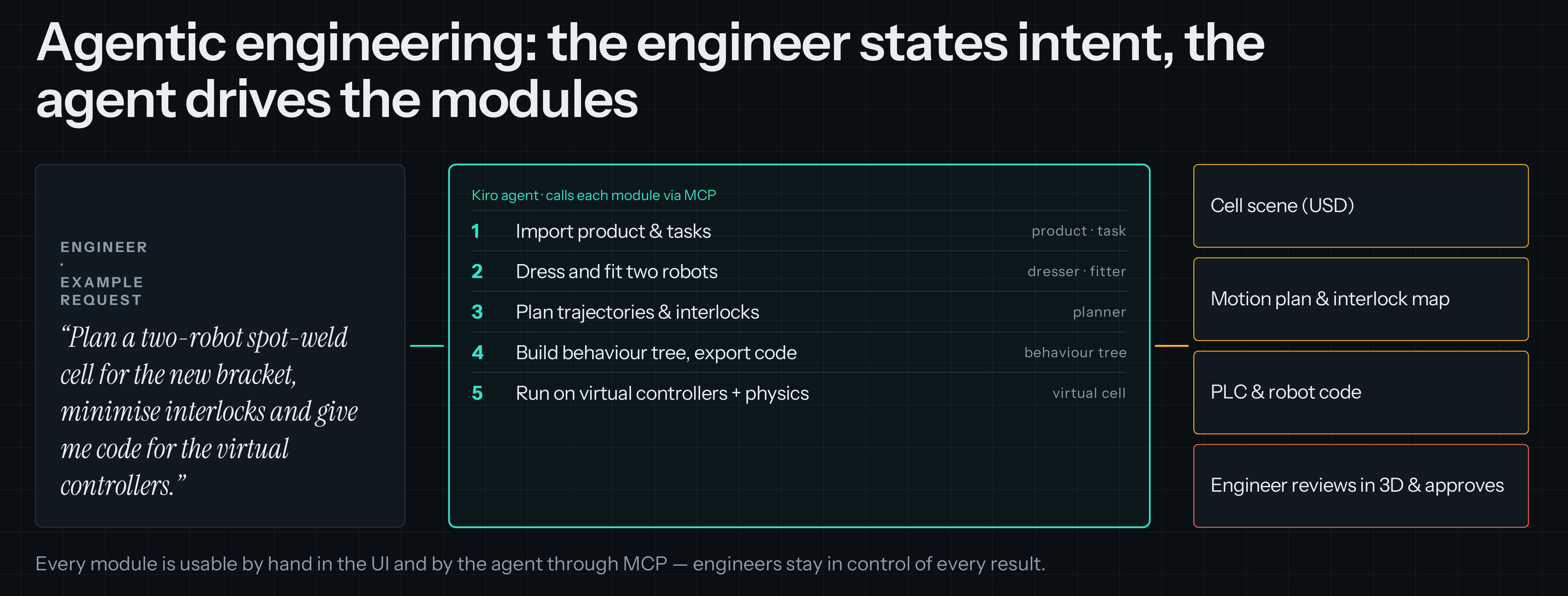
Physical AI Production Designer: Cell Programming from Weeks to Hours
0AWS for Industries