Backend
MorphQuad: Morphable Quadrotor for Superhuman Maneuverability, Manipulation, and Resiliency
arXiv cs.RO0 views
arXiv:2607.02764v5 Announce Type: replace Abstract: Infrastructure maintenance, contact-based inspection, and emergency response can benefit from aerial vehicles that act as a flying human hand with extreme maneuverability, manipulation, and resiliency (MMR): maneuverability to fly in arbitrary orientations; manipulation to point sensors, turn valves, and press tools at arbitrary orientations; resiliency to maintain motion accuracy and force application despite disturbances from arbitrary directions, such as wind, ground effects, and friction. Realizing MMR requires more than omnidirectional flight; it also requires (I) vectoring of maximum thrust in any direction, (II) almost-everywhere stability, accounting for kinematic singularities, control singularities, and inter-rotor downwash interference, and (III) miniaturizable structural designs. Existing aerial vehicles satisfy a subset of I--III. We present MorphQuad, a morphable quadrotor that delivers MMR by realizing I--III on a quadrotor structure with independently articulated rotor systems through novel control and thrust allocation algorithms. On hardware, MorphQuad preserves a planar quadrotor structure, and independently articulates each of the four rotor systems, eliminating control singularities and enabling all rotors to align and vector the platform's maximum thrust in any direction; on control and thrust allocation, MorphQuad enjoys a closed-form null-space correction for gimbal lock and downwash interference that maintains almost-everywhere stability via coupling with a generalized geometric controller. With fully-onboard computation, localization, and trajectory execution, MorphQuad demonstrates continuous multi-revolution rotation while translating or hovering (maneuverability); valve turning, perching, and object pressing and pushing with human-wrist strength (manipulation); and push-pull recovery and wind rejection, even when directed to a single rotor (resiliency).
Source:https://arxiv.org/abs/2607.02764PreviousStable Transformer-Actor-Critic Model Predictive Control: A Contraction Analysis ApproachNextWarpMPC: Large-Batch MPC on GPU via ADMM with Unrolled $LDL^\top$ Factorization
Related posts

Introducing Amazon OpenSearch Memory: Persistent memory for AI agents
0AWS Big Data Blog

How Social Department built culture-aware video discovery
0AWS Machine Learning Blog
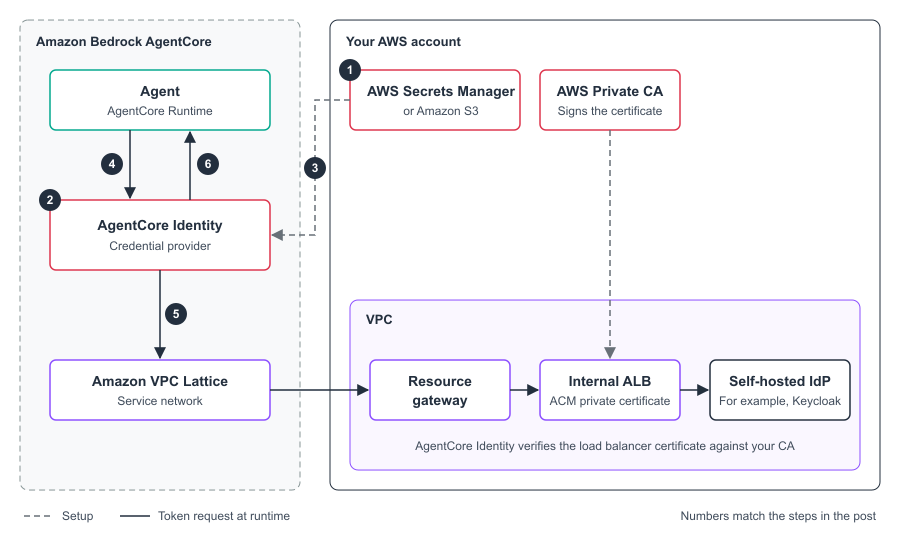
Private certificate authority support in Amazon Bedrock AgentCore Identity
0AWS Machine Learning Blog

CommitFlow: Semantic Commitment Verification and Local Correction for Long-Horizon Robot Manipulation VLA Execution
0arXiv cs.RO

OpenRoIS: A Community-Driven Open-Source Middleware Implementing the Robotic Interaction Service (RoIS) Framework for Physical Robots, Virtual Avatars, and Digital Services
0arXiv cs.RO

Navi-Agent: Unlocalized Monocular Navigation Agent
0arXiv cs.RO