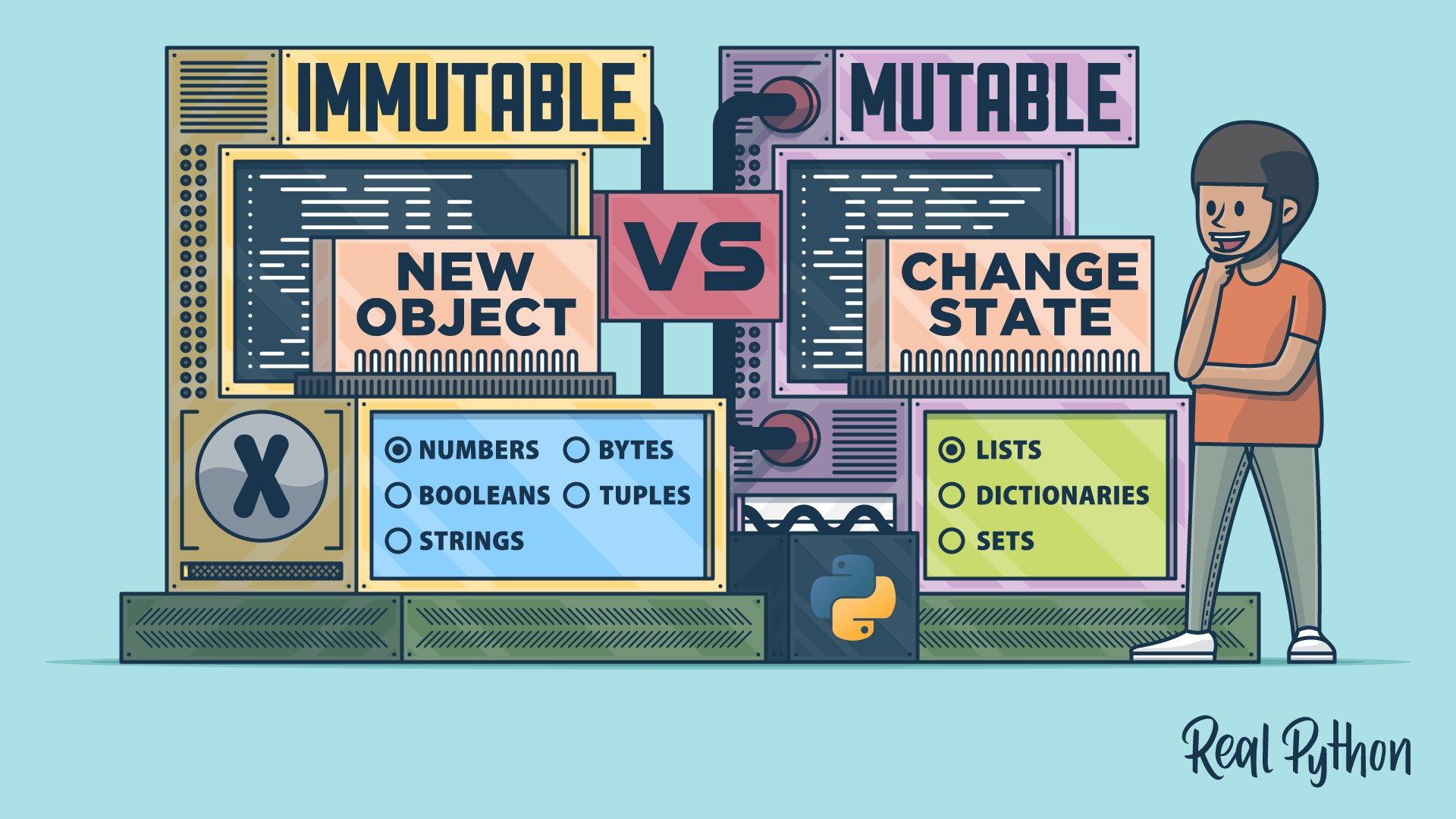
Python’s mutable objects, such as lists and dictionaries, allow you to change their value or data directly without affecting their identity. In contrast, immutable objects, like tuples and strings, don’t allow in-place modifications. Instead, you’ll need to create new objects of the same type with different values.
By the end of this tutorial, you’ll understand that:
- The difference between mutable and immutable objects is that mutable objects can be modified, while immutable objects can’t be altered once created.
- Python lists are mutable, allowing you to change, add, or remove elements.
- Strings in Python are immutable, meaning you can’t change their content after creation.
- To check if an object is mutable, you can try altering its contents. If you succeed without an error, it’s mutable.
In Python, mutability is a characteristic that may profoundly influence your decision when choosing which data type to use for solving a programming problem. Therefore, you need to know how mutable and immutable objects work in Python.
To dive smoothly into this fundamental Python topic, you should be familiar with how variables work in Python. You should also know the basics of Python’s built-in data types, such as numbers, strings, tuples, lists, dictionaries, sets, and others. Finally, knowing how object-oriented programming works in Python is also a good starting point.
Free Sample Code: Click here to download the free sample code that you’ll use to explore mutable vs immutable data types in Python.
Take the Quiz: Test your knowledge with our interactive “Python's Mutable vs Immutable Types: What's the Difference?” quiz. You’ll receive a score upon completion to help you track your learning progress:
Interactive Quiz
Python's Mutable vs Immutable Types: What's the Difference?Find out how Python's mutable and immutable types behave, and see how mutability shapes lists, tuples, dictionaries, and your own classes.
Mutability vs Immutability
In programming, you have an immutable object if you can’t change the object’s state after you’ve created it. In contrast, a mutable object allows you to modify its internal state after creation. In short, whether you’re able to change an object’s state or contained data is what defines if that object is mutable or immutable.
Immutable objects are common in functional programming, while mutable objects are widely used in object-oriented programming. Because Python is a multiparadigm programming language, it provides mutable and immutable objects for you to choose from when solving a problem.
To understand how mutable and immutable objects work in Python, you first need to understand a few related concepts. To kick things off, you’ll take a look at variables and objects.
Variables and Objects
In Python, variables don’t have an associated type or size, as they’re labels attached to objects in memory. They point to the memory position where concrete objects live. In other words, a Python variable is a name that refers to or holds a reference to a concrete object. In contrast, Python objects are concrete pieces of information that live in specific memory positions on your computer.
The main takeaway here is that variables and objects are two different animals in Python:
- Variables hold references to objects.
- Objects live in concrete memory positions.
Both concepts are independent of each other. However, they’re closely related. Once you’ve created a variable with an assignment statement, then you can access the referenced object throughout your code by using the variable name. If the referenced object is mutable, then you can also perform mutations on it through the variable. Mutability or immutability is intrinsic to objects rather than to variables.
However, if the referenced object is immutable, then you won’t be able to change its internal state or contained data. You’ll just be able to make your variable reference a different object that, in Python, may or may not be of the same type as your original object.
If you don’t have a reference (variable) to an object, then you can’t access that object in your code. If you lose or remove all the references to a given object, then Python will garbage-collect that object, freeing the memory for later use.
Now that you know that there are differences between variables and objects, you need to learn that all Python objects have three core properties: identity, type, and value.
Objects, Value, Identity, and Type
In Python, everything is an object. For example, numbers, strings, functions, classes, and modules are all objects. Every Python object has three core characteristics that define it at a foundational level. These characteristics are:
- Value
- Identity
- Type
Arguably, the value is probably the most familiar object characteristic that you’ve dealt with. An object’s value consists of the concrete piece or pieces of data contained in the object itself. A classic example is a numeric value like an integer or floating-point number:
>>> 42 42 >>> isinstance(42, int) True >>> 3.14 3.14 >>> isinstance(3.14, float) True These numeric values, 42 and 3.14, are both objects. The first number is an instance of the built-in int class, while the second is an instance of float. In both examples, you confirm the object’s type using the built-in isinstance() function.
Read the full article at https://realpython.com/python-mutable-vs-immutable-types/ »
[ Improve Your Python With 🐍 Python Tricks 💌 – Get a short & sweet Python Trick delivered to your inbox every couple of days. >> Click here to learn more and see examples ]


